
Peptide PEG MGF: Benefits, Research & Safety Guide
Descubra los beneficios y el interés de investigación del péptido PEG MGF, una forma pegilada del péptido MGF conocida por su señalización en la reparación muscular y la adaptación tisular. Conozca su impacto en la estabilidad y la duración de la actividad, así como los factores que debe considerar antes de explorar los beneficios del péptido PEG MGF.
Resumen
PEG-MGF es una versión pegilada del mechano growth factor (MGF), una variante de empalme del IGF-1 que se produce en respuesta al daño muscular.
Key Information
Mecanismo
Activa las células satélite en el tejido muscular dañado, promoviendo la reparación y el crecimiento local. La pegilación extiende la vida media de minutos a horas.
Benefits
- Reparación muscular dirigida
- Activación de células satélite
- Vida media prolongada (PEG)
- Recuperación post-entrenamiento
Side Effects
- Mínimos reportados
- Reacciones leves en el sitio de inyección
Contraindications
- Active cancer
Evidence Summary
Los estudios demuestran una mayor reparación y crecimiento muscular, especialmente después del ejercicio.
Research
Los estudios demuestran una mayor reparación y crecimiento muscular, especialmente cuando se administra después del ejercicio.
Ver InvestigaciónSafety
Generalmente bien tolerado. Datos limitados de seguridad a largo plazo en humanos.
Peptide PEG MGF: Benefits, Research & Safety Guide
Peptide PEG MGF is commonly discussed in performance, recovery, and peptide research circles because it is associated with muscle repair signaling and tissue adaptation. In simple terms, PEG MGF refers to a pegylated form of MGF peptide, designed for research interest around stability and activity duration. This article explains what it is, why people talk about it, and what to consider before evaluating any claims about peg mgf peptide benefits or use.
What is Peptide PEG MGF?
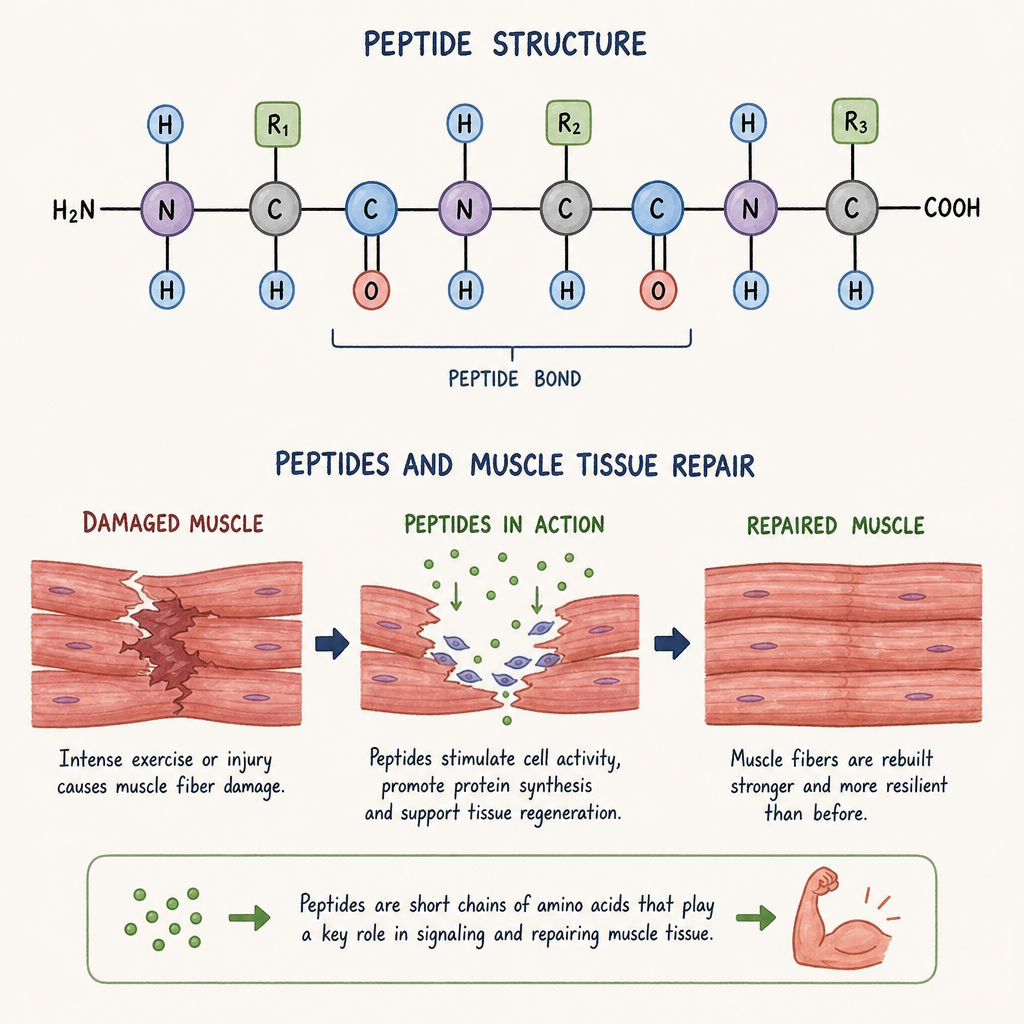
Peptide PEG MGF is a modified version of mechano growth factor, often shortened to MGF, which is a splice variant related to insulin-like growth factor signaling. The "PEG" portion refers to pegylation, a process where polyethylene glycol is attached to a molecule to influence how it behaves in a research setting. Because of this modification, pegylated MGF is often discussed as a longer-acting variation compared with non-pegylated MGF peptide.
MGF is generally associated with the body's response to mechanical stress, such as resistance training or tissue strain. In educational and research conversations, it is often linked to repair pathways, satellite cell activity, and muscle adaptation. However, it is important to separate broad biological theory from proven outcomes in humans, especially when claims become specific or promotional.
The Role of Pegylation in Peptide Design
Pegylation is used in peptide and protein development to alter certain properties of a compound. In practical terms, the goal is often to make a molecule more stable or less rapidly cleared in controlled research environments. That is why the phrase peg mgf appears frequently in discussions about extended activity compared with shorter-lived peptide forms.
For readers new to the topic, this does not mean pegylated MGF is automatically safer, more effective, or appropriate for personal use. It simply means the molecule has been modified in a way that may change its duration, solubility, or handling characteristics. Those details matter because peptide behavior can vary significantly depending on formulation, purity, storage, and context.
Why Are People Interested in Peg MGF Peptide Benefits?
People are interested in peg MGF peptide benefits because MGF is associated with repair and adaptation signals that become relevant after mechanical stress. In theory, this makes the peg mgf peptide appealing to researchers studying muscle recovery, tissue response, and cellular repair pathways. The interest is strongest where the goal is to understand how growth-related signaling may influence adaptation after strain or injury.
Commonly discussed areas include:
- Muscle recovery research: MGF is often connected with post-exercise repair signaling, making it a frequent topic in discussions around resistance training adaptation.
- Satellite cell activity: Some conversations focus on how MGF-related pathways may support cells involved in muscle maintenance and repair.
- Tissue response models: Researchers may examine how growth-factor-related compounds interact with stressed or damaged tissue environments.
- Peptide stability: The pegylated format is often discussed because stability and duration are practical concerns in peptide research.
The key word here is "research." Benefits described online are often extrapolated from early findings, animal models, or theoretical mechanisms. A careful reader should treat dramatic claims with caution and look for human evidence, transparent sourcing, and responsible language.
Common Research-Focused Uses and Discussion Areas
Most conversations about peptide peg mgf fall into a few broad categories. These categories are useful for understanding the topic, but they should not be read as medical recommendations or guaranteed outcomes.
Muscle Adaptation and Repair Signaling
The most common area of discussion is muscle tissue response after mechanical loading. Because MGF is linked with repair-related signaling, it is often mentioned in the same context as training stress, recovery windows, and tissue remodeling. The pegylated version attracts attention because researchers may be interested in whether a longer activity profile changes observed effects.
For readers, the practical takeaway is simple: this compound is not a substitute for training quality, nutrition, sleep, or injury management. Even if a molecule is being studied for repair signaling, real-world recovery is influenced by many factors. Overlooking those basics can lead to unrealistic expectations.
Injury and Tissue Stress Models
Another discussion area involves tissue damage or strain models. In this context, MGF peptide may be explored for how it interacts with repair environments. The focus is usually on cellular behavior rather than broad wellness claims.
This distinction matters. A compound being studied in a controlled model does not mean it has established clinical use for injuries. Anyone dealing with pain, limited mobility, or suspected tissue damage should seek qualified medical evaluation rather than relying on peptide information online.
Longevity and Performance Conversations
Peg mgf also appears in broader performance and longevity discussions. These conversations can be especially mixed in quality. Some are educational and cautious, while others overstate what is known.
A practical approach is to ask what kind of evidence supports each claim. Is the source explaining mechanisms, or promising results? Is it clear about limitations? Does it distinguish between research use and approved medical use? Those questions help keep expectations grounded.
Responsible Evaluation Matters
Interest in peg mgf peptide benefits should be balanced with a careful look at evidence, safety, and product quality. Peptides can be sensitive compounds, and poor handling or unclear sourcing can create additional risk. Even educational content should avoid treating them like ordinary supplements.
Before trusting any claim about peptide PEG MGF, consider the following checklist:
- Evidence quality: Look for clear references to research rather than vague promises.
- Claim strength: Be cautious when a source guarantees muscle growth, healing, fat loss, or rapid recovery.
- Use context: Check whether the discussion is about laboratory research, animal studies, clinical medicine, or personal experimentation.
- Product transparency: Responsible suppliers usually provide basic details such as identity, purity testing, batch information, and storage guidance.
- Health context: Medical history, medications, endocrine health, injuries, and training load can all change risk.
- Professional guidance: Questions involving health, dosing, injections, or injury recovery should be discussed with a qualified clinician.
What Should You Know About Peg MGF Peptide Dosage?
Peg MGF peptide dosage is a topic that should be approached carefully because dosing depends on legal status, research context, compound quality, individual health factors, and intended use. Public dosage claims are often inconsistent, and copying protocols from forums or product pages can be risky. For that reason, this article does not provide dosing instructions or suggest a personal-use protocol.
If dosage is being discussed in a legitimate research setting, it should be defined by an approved protocol, appropriate oversight, and accurate measurement. If dosage is being discussed for personal use, the safest next step is to speak with a licensed healthcare professional who understands peptides, endocrine signaling, and your health history.
A few practical points are still worth understanding:
- More is not automatically better. Growth-factor-related pathways can be complex, and excessive or poorly planned use may increase risk.
- Purity affects reliability. An unknown or contaminated product makes any dosage discussion less meaningful.
- Storage and handling matter. Peptides may degrade if they are stored or reconstituted incorrectly.
- Individual context matters. Body size, training status, injury history, and health conditions can change risk considerations.
Separating Realistic Expectations From Hype
The strongest marketing around pegylated MGF often makes the compound sound simple: take a peptide, recover faster, build more muscle, and move on. Biology is not that neat. Muscle repair and growth involve training stimulus, protein intake, energy availability, sleep quality, inflammation management, hormones, and time.
A more realistic view is that peg mgf is a research-interest peptide connected to mechanisms that may matter in tissue adaptation. That does not make every benefit claim reliable. It also does not make the compound appropriate for everyone, or even necessary for most people seeking better recovery.
For athletes and active adults, the foundation remains familiar but powerful:
- Follow a progressive training plan instead of constantly chasing fatigue.
- Eat enough protein and total calories to support repair.
- Prioritize sleep, especially during high-volume training blocks.
- Manage injuries early rather than training through worsening pain.
- Use lab testing and clinical guidance when exploring hormone- or peptide-related options.
These basics may sound less exciting than a new compound, but they are usually the highest-value place to start.

Quality, Legality, and Safety Considerations
Peptides are not all produced, labeled, or tested to the same standard. This makes quality control one of the most important issues in any discussion of peptide peg mgf. A label alone does not confirm identity, purity, concentration, sterility, or proper handling.
Legality and permitted use can also vary by location and context. A compound may be sold for research purposes but not approved for human use, or it may be restricted in competitive sports. If a reader is subject to drug testing or professional rules, they should verify the relevant regulations through official channels before considering any peptide-related product.
Safety considerations should include more than immediate side effects. Growth-factor-related signaling can interact with complex biological systems, and long-term implications may not be fully defined for many research peptides. That uncertainty is a reason to be cautious, not casual.
Key Takeaways
Peptide PEG MGF is a pegylated form of MGF peptide that attracts attention because of its connection to muscle repair signaling and the potential stability advantages associated with pegylation. It is most responsibly discussed in a research and educational context, not as a guaranteed shortcut for recovery or muscle growth.
The most important takeaways are:
- Pegylated MGF is discussed for its relationship to repair and adaptation pathways.
- The PEG modification may influence stability and duration in research contexts.
- Benefits are often theoretical, early-stage, or dependent on context.
- Peg MGF peptide dosage should not be copied from unverified online sources.
- Product quality, legality, health status, and professional oversight matter.
- Recovery fundamentals still play the biggest practical role for most people.
Used as a learning topic, peg mgf can help readers understand how peptide research intersects with muscle biology. Used casually or without guidance, it can create unnecessary risk. The smartest approach is to stay curious, stay critical, and treat any health-related decision as something that deserves qualified professional input.
Related Muscle Growth Peptides
Key Research Papers on Peptide PEG MGF: Benefits, Research & Safety Guide
The following peer-reviewed studies and clinical trials are indexed in our research library for Peptide PEG MGF: Benefits, Research & Safety Guide. Each paper links to a detailed summary with key findings, study design, and publication metadata.
- Gene expression in response to muscle stretch — Clin Orthop Relat Res, 2002 (480 citations)
- Mechano-growth factor peptide, the COOH terminus of unprocessed insulin-like growth factor 1, has no apparent effect on myoblasts or primary muscle stem cells — Am J Physiol Endocrinol Metab, 2014 (240 citations)
- The role of mechano-growth factor E peptide in the regulation of osteosarcoma — Oncol Lett, 2015 (220 citations)
- MGF E peptide improves anterior cruciate ligament repair by inhibiting hypoxia-induced cell apoptosis and accelerating angiogenesis — J Cell Physiol, 2019 (140 citations)
Related Muscle growth / Anabolic Peptides
Other peptides in the muscle growth / anabolic category that may be of interest for comparative research:
No vendor prices yet
We don't have pricing data for this peptide yet.
Write a Review
Login to write a review
You need an account to share your experience with Peptide PEG MGF: Benefits, Research & Safety Guide.
RegistrarseRating Breakdown
Based on 2 reseñas.
Reseñas
PEG-MGF is my go-to for injury recovery. Muscle tears heal twice as fast. The extended half-life means less frequent dosing. Stack with IGF-LR3 for maximum anabolic effect. Very effective and relatively safe.
PEG-MGF is perfect for post-workout recovery. Satellite cell activation helps repair muscle damage faster. The PEGylation extends the half-life significantly. Less potent than IGF-LR3 for growth but better for recovery.