
Peptide purity testing expenses can feel confusing because "testing" may mean a simple chromatographic purity check, a broader identity confirmation, or a more complete panel that includes content, contaminants, and documentation. The real value is not just the number on the invoice; it is the confidence you gain in what a peptide sample contains, how it was measured, and whether the report can be traced back to a qualified third party.
For buyers, researchers, and businesses comparing options, understanding the peptide purity testing cost means looking at method, sample volume, turnaround time, reporting quality, and location. A low peptide testing price may be perfectly reasonable for a narrow screen, while a higher quote may reflect more instrumentation, validation, or documentation.
What Does Peptide Purity Testing Usually Include?
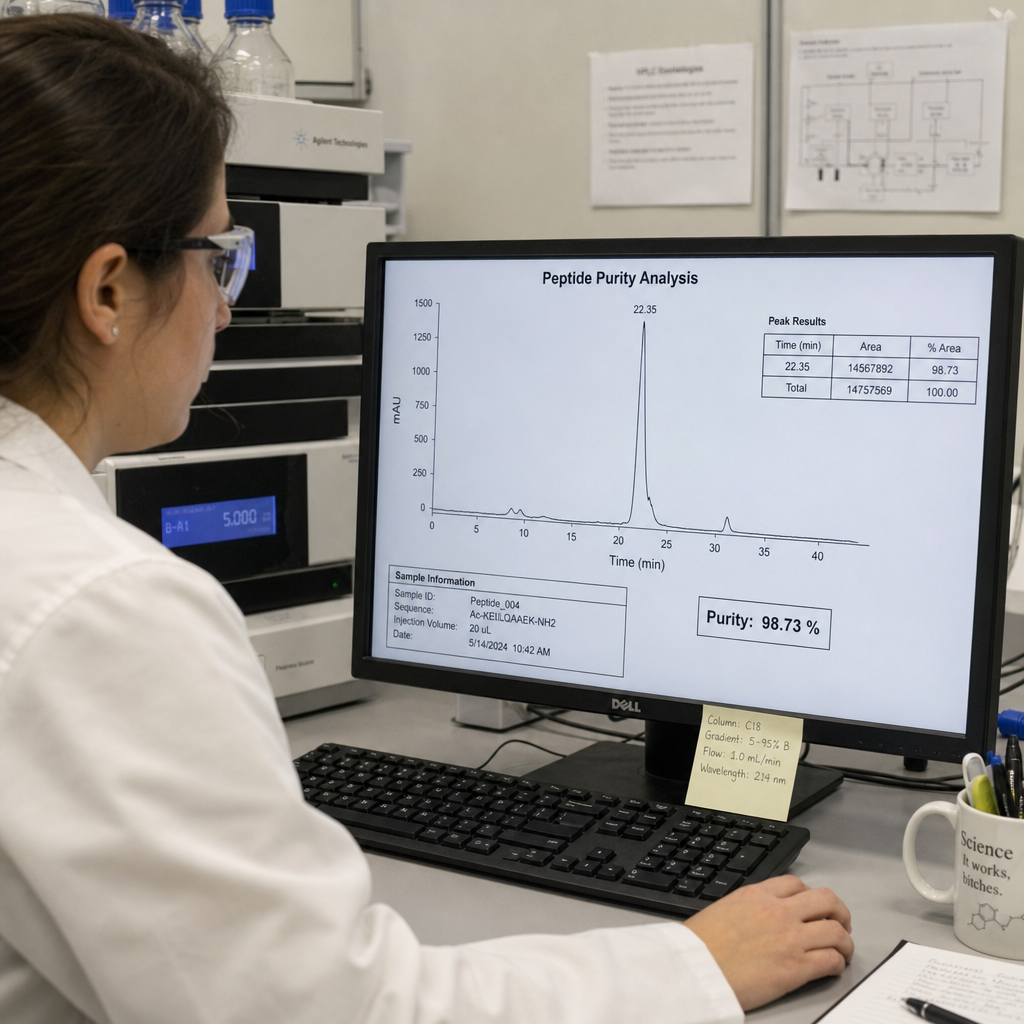
Peptide purity testing usually checks how much of the sample appears to be the intended peptide versus related impurities, degradation products, or other detectable components. In many commercial testing services, this starts with HPLC or HPLC-UV for purity and may be paired with LC-MS or mass spectrometry for identity confirmation.
Several current third party peptide testing providers describe combined HPLC and LC-MS workflows for peptide identity and purity checks, which is why those methods often appear together on quotes.
That distinction matters. HPLC can estimate chromatographic purity, but it does not automatically prove that the main peak is the correct molecule. LC-MS helps confirm molecular identity, while additional tests may be needed for net peptide content, sterility, endotoxin, residual solvents, or heavy metals depending on the intended research use and risk profile.
A basic report may include a chromatogram, peak area percentages, sample information, method notes, and a certificate of analysis. A stronger report is usually batch-specific, traceable, and issued by the lab rather than edited or repackaged by a seller.
Why Does Peptide Purity Testing Cost Vary So Much?
Peptide purity testing cost varies because labs are not always quoting the same scope of work. One quote may cover only HPLC purity, another may include LC-MS identity confirmation, and another may add quantitative content testing, method development, expedited handling, or a public certificate of analysis.
Published market examples show this spread clearly: one provider advertises independent testing from $150 per research peptide vial, while another lists purity plus identity panels in a higher range depending on the package. (kmdanalytical.com)
The biggest cost drivers are practical. Each test requires sample intake, preparation, instrument time, analyst review, reporting, and quality checks. If the peptide is unusual, modified, unstable, difficult to dissolve, or supplied without adequate reference information, the lab may need more time to create a suitable method.
Common factors that influence peptide purity testing lab cost include:
- Test method: HPLC-only testing is generally simpler than a combined HPLC and LC-MS package.
- Identity confirmation: Mass spectrometry adds value but also adds instrument time and interpretation.
- Quantitative content: Net peptide content or potency-style analysis may require different methods from purity testing.
- Sample complexity: Modified peptides, mixtures, salts, excipients, or unclear labeling can increase preparation work.
- Turnaround time: Rush service, when available, often costs more than standard processing.
- Documentation: A detailed COA, chain-of-custody record, and public verification system may affect the final quote.
- Batch volume: Multiple samples may qualify for lower per-sample pricing, but this depends on the lab.
In short, the cheapest option is not always poor, and the most expensive option is not automatically better. The question is whether the quote matches the decision you need to make from the data.
The Main Types of Peptide Testing Expenses
When comparing quotes, it helps to separate the base test from the add-ons. A lab may advertise one headline peptide testing price, but the final invoice can change once you specify the peptide, method, reporting needs, shipping situation, and number of samples.
Basic Purity Testing
Basic purity testing is commonly built around HPLC. It is often used to estimate the proportion of the main chromatographic peak compared with detectable impurities under the method used. This can be useful for screening, supplier checks, and batch comparison.
However, HPLC purity alone should not be treated as a complete identity or safety assessment. A sample can show a strong main peak and still require identity confirmation or additional contaminant testing for a more complete picture.
Purity Plus Identity Confirmation
Many buyers choose a combined package because it answers two different questions: "How clean does the sample appear?" and "Is the main molecule consistent with the expected peptide?" Labs that offer third party peptide testing commonly pair HPLC purity with LC-MS identity confirmation for this reason.
This option typically costs more than HPLC alone, but it is often more useful when verifying supplier claims. If you are paying for only one independent check, purity plus identity is usually a more informative baseline than purity by itself.
Content, Contaminants, and Specialty Tests
Some situations require more than purity and identity. Net peptide content can help assess how much peptide is actually present in a vial, while endotoxin, sterility, residual solvent, or heavy metal testing may be relevant depending on the sample and use case.
These tests should not be assumed to be included. Always ask what is covered, what is excluded, how results are expressed, and whether the lab can explain the limitations of each method in plain language.
How to Compare Quotes Without Choosing on Price Alone
A good comparison starts with a consistent request. If you ask three labs for "peptide testing," one may quote HPLC only, another may quote HPLC plus LC-MS, and a third may include additional documentation. That makes the prices look inconsistent even when each lab is responding reasonably.
Use this checklist before choosing a lab:
- Define the goal. Are you checking purity, confirming identity, measuring content, or investigating a suspected issue?
- Confirm the method. Ask whether the quote includes HPLC, LC-MS, both, or another technique.
- Ask what the COA includes. Look for sample ID, batch information, method summary, chromatogram, interpretation, and lab contact details.
- Check independence. For supplier verification, third party peptide testing is more useful when the lab is independent from the seller.
- Clarify sample requirements. Ask how much material is needed, how it should be packaged, and whether the sample is consumed during testing.
- Understand timelines. Some current labs publish standard turnaround windows, such as several business days after receipt, but timing can vary by workload and method. (crafa.online)
- Review limitations. A credible lab should be able to explain what its test can and cannot prove.
If a quote is vague, ask for a written scope. Clear scope protects both sides and helps you avoid paying for a result that does not answer your real question.
What Should You Expect When Searching for Testing Near You?
When people search for peptide purity testing cost near me or peptide purity testing lab cost near me, they are usually hoping for a convenient local option. Location can matter for shipping time, sample handling, and communication, but analytical capability is more important than proximity. A qualified lab in another region may provide better documentation than a nearby provider with limited methods.
For U.S. searches, you may find independent analytical labs, research-compound testing services, university core facilities, and specialty providers. Some publish pricing or estimators, while others require a quote based on the sample and requested panel. For UK searches, terms like peptide purity testing cost uk may surface services that advertise UK-based peptide verification using HPLC and LC-MS workflows.
Before shipping anything, check whether the lab accepts your sample type and whether there are restrictions related to controlled substances, biological materials, or international shipping. Do not assume a lab can receive every peptide simply because it offers peptide analysis.
Red Flags That Can Make a Cheap Test Expensive
A low price can become costly if the report is incomplete, unverifiable, or unsuitable for your purpose. The point of testing is to reduce uncertainty, not create a document that raises more questions.
Watch for these red flags:
- A certificate that does not name the testing lab clearly.
- No batch number or mismatch between vial, order, and report.
- No chromatogram or raw-method context for a claimed purity number.
- Purity claims without identity confirmation when identity is important.
- Refusal to explain whether HPLC, LC-MS, or another method was used.
- Overly broad claims such as "safe," "pharmaceutical grade," or "approved" without appropriate evidence.
- Reports supplied only by a seller when independent verification is needed.
A reliable lab does not need to overpromise. It should tell you what was tested, how it was tested, what was found, and what the result does not establish.
Budgeting for Peptide Testing in a Practical Way
A sensible budget starts with risk. If you are doing a quick supplier screen, a basic or mid-level panel may be enough. If the result will support a purchasing decision, product release, research record, or dispute, it may be worth paying for stronger documentation and identity confirmation.
You can manage peptide purity testing lab cost by grouping samples, avoiding unnecessary rush service, and asking the lab which panel fits your objective. Be careful, though, about cutting the test that answers the central question. If you need to confirm identity, choosing purity-only testing to save money may leave you without the most important answer.
It also helps to think in terms of total cost rather than the lab fee alone. Include shipping, replacement sample value, retesting if the sample fails, delays while waiting for results, and the cost of making a wrong decision from incomplete data.
Key Takeaway
The peptide purity testing cost depends on scope, not just location or lab name. HPLC purity, LC-MS identity confirmation, content testing, contaminant screening, turnaround time, and reporting quality all influence the final peptide testing price.
If you are comparing peptide purity testing cost near me, peptide purity testing cost uk, or broader third party peptide testing options, ask each lab for the same clearly defined scope. The best choice is the service that gives you reliable, traceable information for the decision you need to make, without paying for extras you do not need or skipping tests that matter.