
GHK-Cu Peptide Dosing Guide: Optimal Injection Protocols
Explore our comprehensive guide on GHK-Cu peptide dosing to enhance skin quality and tissue repair. Discover typical injection dosages and schedules for optimal health outcomes.
Overview
GHK-Cu is a copper-binding peptide used in clinician-guided peptide plans for skin quality, tissue repair support, and healthy-looking aging. This guide explains common GHK-Cu peptide injection dosage ranges, how a typical peptide dosing schedule is organized, and how to read a practical GHK-Cu dosage chart without treating it as a personal prescription. Use it as an educational peptide dosing guide to prepare for a conversation with a qualified medical provider. You can use our GHK-Cu dosage calculator → to plan protocol schedules and check reconstitution math — for educational purposes only, not for self-dosing.
What is GHK-Cu peptide injection dosage?
GHK-Cu peptide injection dosage refers to the amount of copper tripeptide used in a subcutaneous injection protocol, usually measured in milligrams per day. In many provider-directed protocols, the commonly referenced injectable range is about 0.5 mg to 3 mg daily, with a frequently used schedule of 1 mg daily for days 1-15, then 2 mg daily for days 16-30, followed by a rest period. These ranges are educational, not self-administration instructions, and should be individualized by a licensed clinician. (bhrcenter.com)
GHK-Cu itself is the copper-bound form of the naturally occurring tripeptide glycyl-L-histidyl-L-lysine. Research reviews describe it as a signaling molecule associated with skin renewal, wound-healing pathways, collagen support, and tissue remodeling activity. (pubmed.ncbi.nlm.nih.gov)
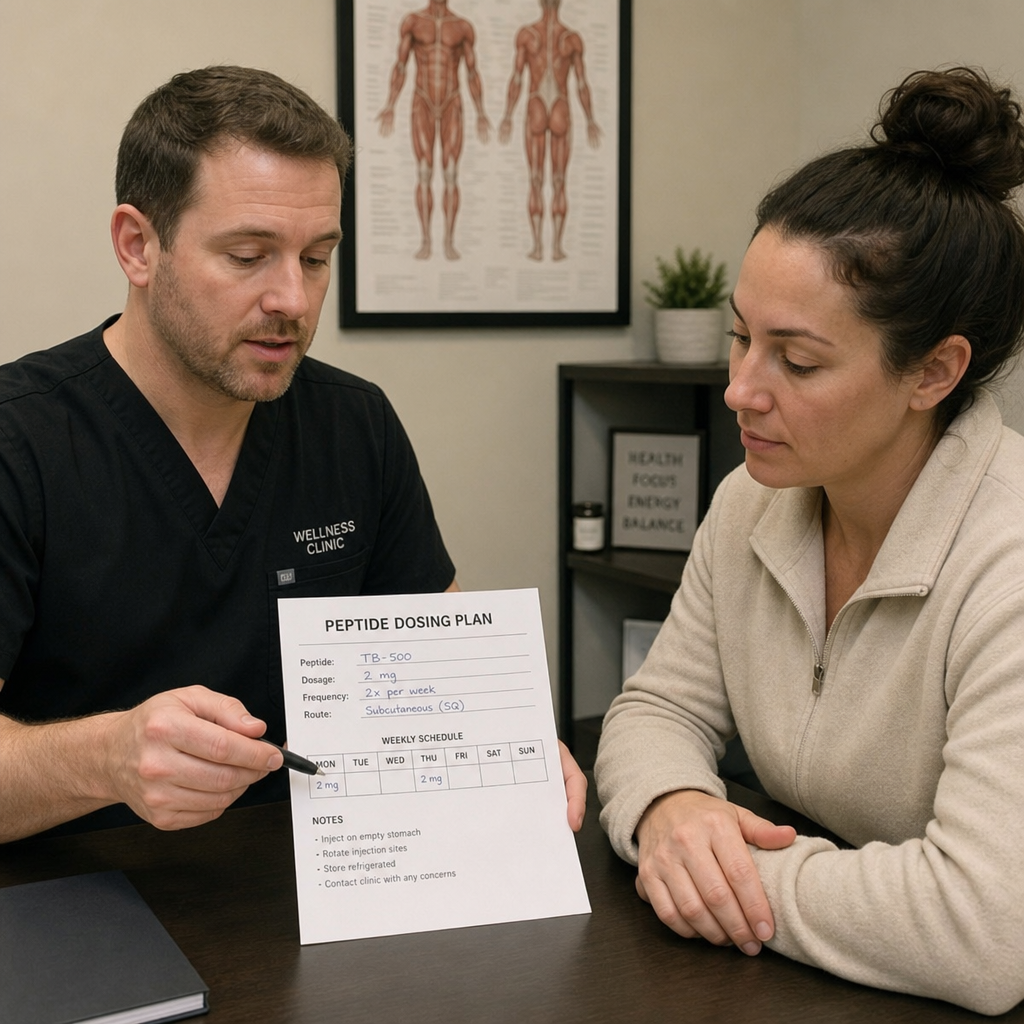
GHK-Cu dosage chart in text format
The chart below summarizes common clinician-guided GHK-Cu dosing patterns. It is designed to make ghk cu peptide dosing easier to understand, but the right ghk-cu protocol depends on the person, product concentration, health history, and provider plan. If you want to organize a protocol schedule or check reconstitution math, use our GHK-Cu dosage calculator → — but only as a conversation tool, not a self-treatment plan.
| Approach | Amount | Frequency | Cycle | Use Case |
| Conservative starting | 0.5-1 mg | Once daily | Defined on/off cycle | First-time users, gradual introduction, general skin and wellness |
| Standard 30-day escalation | 1 mg (days 1-15), 2 mg (days 16-30) | Once daily | 30 days on, 30 days off | Skin quality, healthy aging, regenerative wellness |
| Steady daily | 1-2 mg | Once daily | Defined on/off cycle | Returning patients, consistent dose preferred by clinician |
| Higher-intensity supervised | 2-3 mg | Once daily | Short defined cycle | Focused tissue-repair or connective-tissue support |
| Common cycle rhythm | Varies | Once daily | ~30 days active, ~30 days rest | Reassessment before continuing |
Conservative starting approach
- Typical amount: 0.5 mg to 1 mg once daily
- Common timing: Often once daily during the active cycle
- Typical use case: First-time users in a supervised setting, gradual introduction, general skin and wellness goals
- Practical note: This range gives the provider room to assess response before moving into a standard ghk-cu dosage pattern.
Standard 30-day escalation approach
- Typical amount: 1 mg once daily for days 1-15
- Step-up amount: 2 mg once daily for days 16-30
- Common cycle: 30 days on, followed by 30 days off
- Typical use case: Skin quality, healthy aging support, and broader regenerative wellness planning
- Practical note: This is one of the most commonly cited ghk-cu peptide injection schedules in provider-directed content. (bhrcenter.com)
Steady daily approach
- Typical amount: 1 mg to 2 mg once daily
- Common cycle: Usually structured within a defined on-cycle and rest period
- Typical use case: Returning patients whose clinician prefers a consistent dose rather than a mid-cycle increase
- Practical note: The steady approach can simplify the peptide dosing schedule when the provider has already established an appropriate daily amount.
Higher-intensity supervised approach
- Typical amount: 2 mg to 3 mg once daily
- Common cycle: Short, defined cycle under closer medical oversight
- Typical use case: More focused tissue-repair or connective-tissue support goals
- Practical note: This level belongs in a carefully personalized plan rather than a generic ghk cu peptide dosing chart.
Common cycle rhythm
- Active phase: About 30 days
- Rest phase: About 30 days
- Practical note: Many ghkcu dosage plans use cycling so the provider can reassess goals, timing, and overall protocol before continuing.
How does GHK-Cu support skin and repair goals?
GHK-Cu is valued because it appears to support several pathways involved in visible skin quality and tissue renewal. Reviews describe GHK-Cu as being associated with collagen and glycosaminoglycan synthesis, extracellular-matrix remodeling, antioxidant activity, and wound-healing signals. In practical terms, this is why people often discuss dosing for ghk cu peptide in the context of smoother-looking skin, post-procedure recovery planning, and connective-tissue support. (pubmed.ncbi.nlm.nih.gov)
Its copper component matters because copper is involved in normal biological processes related to tissue structure and repair. Rather than thinking of GHK-Cu as a simple "more is better" compound, it is more useful to view it as a signaling peptide that works best when the dose, timing, and cycle are thoughtfully matched to the goal.
For many readers, the biggest benefit of a clear ghk-cu peptide injection dosage guide is confidence. You can walk into a provider visit understanding the difference between 0.5 mg, 1 mg, and 2 mg dosing, what a 30-day cycle means, and which questions to ask before beginning.
Matching the protocol to the goal
A good peptide dosing guide does not treat every wellness goal the same. Skin-focused plans may emphasize consistency, gradual changes, and coordination with topical skincare. Tissue-support plans may focus more on timing, cycle length, and whether GHK-Cu belongs alongside other peptides in a broader program.
Common goal-based patterns include:
1. Healthy-looking skin and aging support — Many plans use 1 mg to 2 mg daily during the active phase. The focus is usually gradual improvement in skin texture, firmness, and overall appearance, especially when paired with smart skincare and healthy lifestyle habits.
2. Post-procedure skin support — Some providers coordinate GHK-Cu around aesthetic procedures because topical GHK-Cu has been studied in skin recovery contexts, including after resurfacing procedures. The exact timing should come from the treating clinician so the injection plan and skincare plan work together. (bhrcenter.com)
3. Connective-tissue and recovery support — A provider may consider the upper end of common ghk-cu dosage ranges, such as 2 mg to 3 mg daily, when the plan is more repair-focused. This is where personalization is especially important because the overall program may include movement, nutrition, sleep, and other therapies.
4. General regenerative wellness planning — A standard 1 mg to 2 mg daily structure is often discussed for broader wellness goals. The main advantage is simplicity: a defined dose, a defined active cycle, and a defined reassessment point.
How should a peptide dosing schedule be organized?
A peptide dosing schedule should be organized around the dose, frequency, cycle length, route, and reassessment point. For GHK-Cu, that often means once-daily subcutaneous dosing during a defined active cycle, followed by time away from the peptide before deciding whether another cycle fits the plan. (bhrcenter.com)
A practical schedule should answer these questions clearly:
- Daily amount: Is the plan 0.5 mg, 1 mg, 2 mg, or another clinician-selected amount?
- Frequency: Is the injection once daily, or has the provider selected another rhythm?
- Cycle length: Is the active phase 30 days, shorter, or longer?
- Rest period: When does the protocol pause for reassessment?
- Goal marker: What visible or functional changes will be reviewed?
- Combination plan: Is GHK-Cu being used alone, with topical copper peptides, or as part of a broader peptide protocol?
This kind of structure keeps the protocol practical. Instead of chasing random online ghk cu peptide dosing numbers, you are using a framework that can be adjusted responsibly. Our GHK-Cu dosage calculator → can help organize this framework, but the medical decisions belong to a qualified clinician.
Where GHK-Cu fits with other peptides
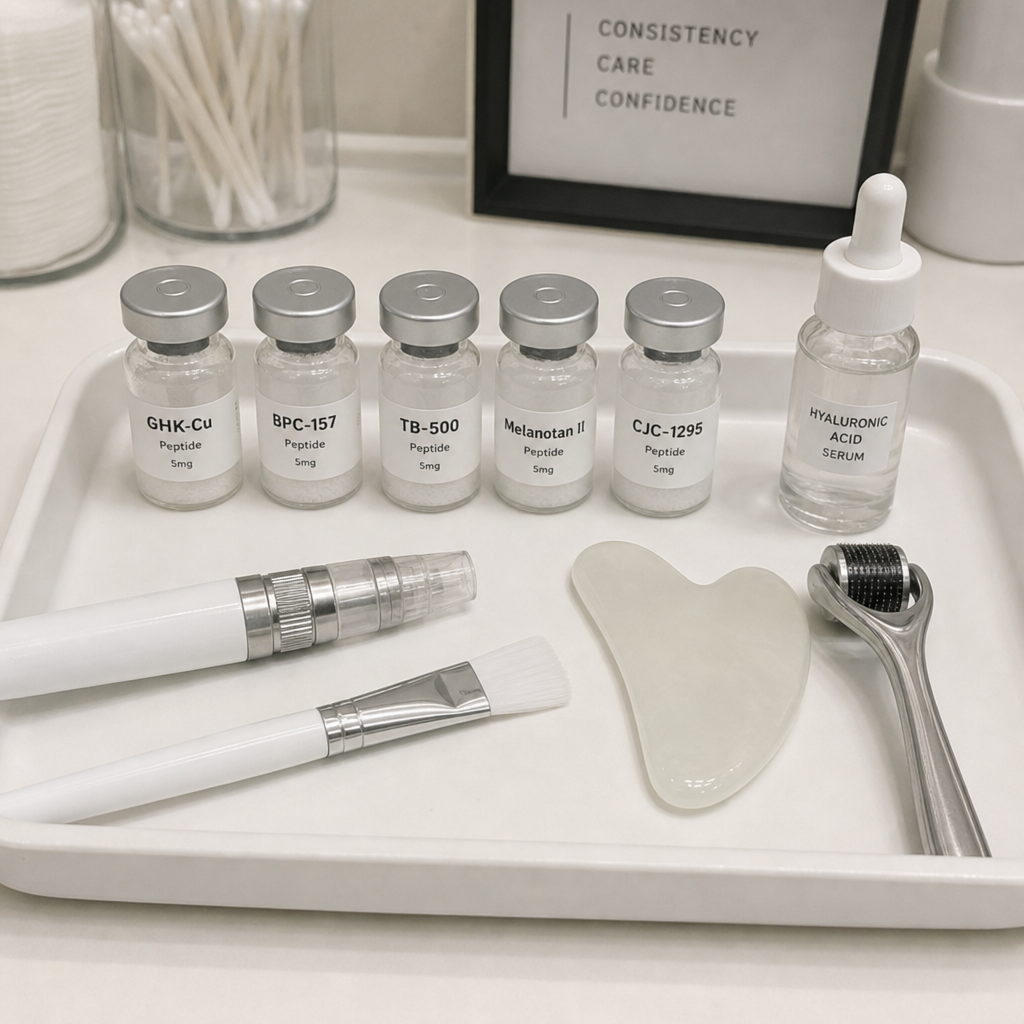
GHK-Cu is often discussed alongside repair-focused peptides because its main appeal is skin and tissue-support signaling. In regenerative and sports-medicine literature, peptides such as BPC-157, TB-4/TB-500, and GHK-Cu are commonly reviewed for their potential roles in tissue repair pathways, angiogenesis, extracellular-matrix remodeling, and recovery biology. (pubmed.ncbi.nlm.nih.gov)
That is why the phrase bpc 157 tb 500 blend benefits often appears in the same conversations as GHK-Cu. BPC-157 is commonly discussed for tendon, ligament, muscle, and soft-tissue models, while TB-500 is linked to thymosin beta-4 pathways involved in cell migration, wound closure, and tissue remodeling. (pmc.ncbi.nlm.nih.gov)
GHK-Cu brings a different emphasis: skin quality, copper-peptide signaling, collagen support, and visible rejuvenation goals. When a clinician combines peptides, the goal is not simply to add more compounds; it is to match complementary mechanisms to a specific outcome.
Smart questions to ask before starting
Before beginning a ghk-cu peptide injection plan, bring specific questions to your provider. This keeps the conversation efficient and helps ensure the ghk-cu protocol is built around your actual goals.
Ask:
- What daily ghk-cu dosage do you recommend for my goal, and why?
- Will my plan use a steady dose or a 1 mg to 2 mg escalation?
- How long is the active cycle, and when do we reassess?
- Should topical copper peptides be part of the plan?
- How will this fit with my skincare, recovery, nutrition, or training routine?
- If using a blend, what role does each peptide play in the overall protocol?
These questions turn a generic peptide dosing guide into a useful clinical conversation. They also help you understand whether your plan is focused on skin appearance, recovery support, or a broader wellness outcome.
Key takeaways
GHK-Cu is a well-known copper peptide used in provider-guided plans for skin quality, tissue-support goals, and healthy-aging routines. The most commonly discussed ghk-cu peptide injection dosage range is 0.5 mg to 3 mg daily, with many standard protocols using 1 mg daily for the first 15 days, then 2 mg daily for the next 15 days, followed by a rest period. (bhrcenter.com)
The best approach is not to copy a chart blindly. Use the ghk cu peptide dosing chart as a conversation tool, then let a qualified provider personalize the protocol to your goals, timing, and overall wellness plan. Our GHK-Cu dosage calculator → can help you understand the dosing math, but the protocol decisions belong to a qualified clinician. With clear dosing, thoughtful cycling, and realistic expectations, GHK-Cu can fit neatly into a practical peptide strategy focused on looking, feeling, and recovering well.
Related Peptides
Frequently Asked Questions
What is the typical GHK-Cu peptide injection dosage range?
The commonly referenced injectable range is 0.5 mg to 3 mg daily, with a frequently used schedule of 1 mg daily for days 1-15, then 2 mg daily for days 16-30, followed by a rest period. These ranges are educational and should be individualized by a licensed clinician.
How long is a typical GHK-Cu cycle?
Many protocols use a 30-day active phase followed by a 30-day rest period. This cycling allows the provider to reassess goals, timing, and overall protocol before continuing.
Can I use GHK-Cu with other peptides?
GHK-Cu is often discussed alongside BPC-157 and TB-500 in tissue-repair contexts. When a clinician combines peptides, the goal is to match complementary mechanisms to a specific outcome, not simply to add more compounds.
Is GHK-Cu a peptide or a copper supplement?
GHK-Cu is the copper-bound form of the naturally occurring tripeptide glycyl-L-histidyl-L-lysine. It is a signaling peptide associated with skin renewal, wound-healing pathways, collagen support, and tissue remodeling activity.
Should I use topical copper peptides alongside injectable GHK-Cu?
Some providers coordinate topical and injectable GHK-Cu, especially around aesthetic procedures. The exact timing and combination should come from your treating clinician so both plans work together.
References
- BHR Center. GHK-Cu Dosage Injection Protocol Guide. bhrcenter.com
- PubMed. GHK-Cu as a signaling molecule for skin renewal and tissue repair. pubmed.ncbi.nlm.nih.gov/18644225
- PubMed. Peptides in tissue repair: BPC-157, TB-4, and GHK-Cu. pubmed.ncbi.nlm.nih.gov/41476424
- PMC. Thymosin beta-4 and tissue remodeling pathways. pmc.ncbi.nlm.nih.gov/articles/PMC12446177