
TB-500 Thymosin Beta 4: Benefits, Risks & Dosage
Découvrez la science derrière le TB-500 thymosin beta 4, comprenez les bienfaits potentiels et apprenez pourquoi les considérations de sécurité et réglementaires sont cruciales. Obtenez des informations sur le dosage du TB-500 et des comparaisons avec le thymosin beta 4 pour prendre des décisions éclairées.
Aperçu
TB-500 est une version synthétique du thymosin beta-4, un peptide d'origine naturelle qui favorise la migration cellulaire, la cicatrisation des plaies et la réparation des tissus dans tout l'organisme.
Key Information
Mechanism
Régule à la hausse la séquestration de l'actine et la migration cellulaire, favorise l'angiogenèse et réduit l'inflammation au niveau des sites de blessure.
Benefits
- Favorise la cicatrisation des plaies
- Améliore la migration cellulaire
- Réduit l'inflammation
- Potentiel de réparation cardiaque
Side Effects
- Minimal rapporté
Contraindications
- None established
Evidence Summary
Les études animales montrent une récupération améliorée après diverses blessures.
Research
Des études animales montrent une amélioration de la récupération après des lésions musculaires et des dommages cardiaques, ainsi qu'une meilleure cicatrisation des plaies.
View ResearchSafety
Généralement bien toléré. Données de sécurité limitées chez l'humain.
TB-500 Thymosin Beta 4: Benefits, Risks & Dosage
TB-500 is commonly discussed as a recovery-focused peptide connected to thymosin beta 4, a naturally occurring peptide involved in cell movement, actin regulation, inflammation signaling, and tissue repair research. The key point for readers is simple: many claimed tb 500 benefits are extrapolated from thymosin beta 4 studies, while TB-500 itself has limited human evidence and no approved medical dosing standard.
What is TB-500 Thymosin Beta 4?
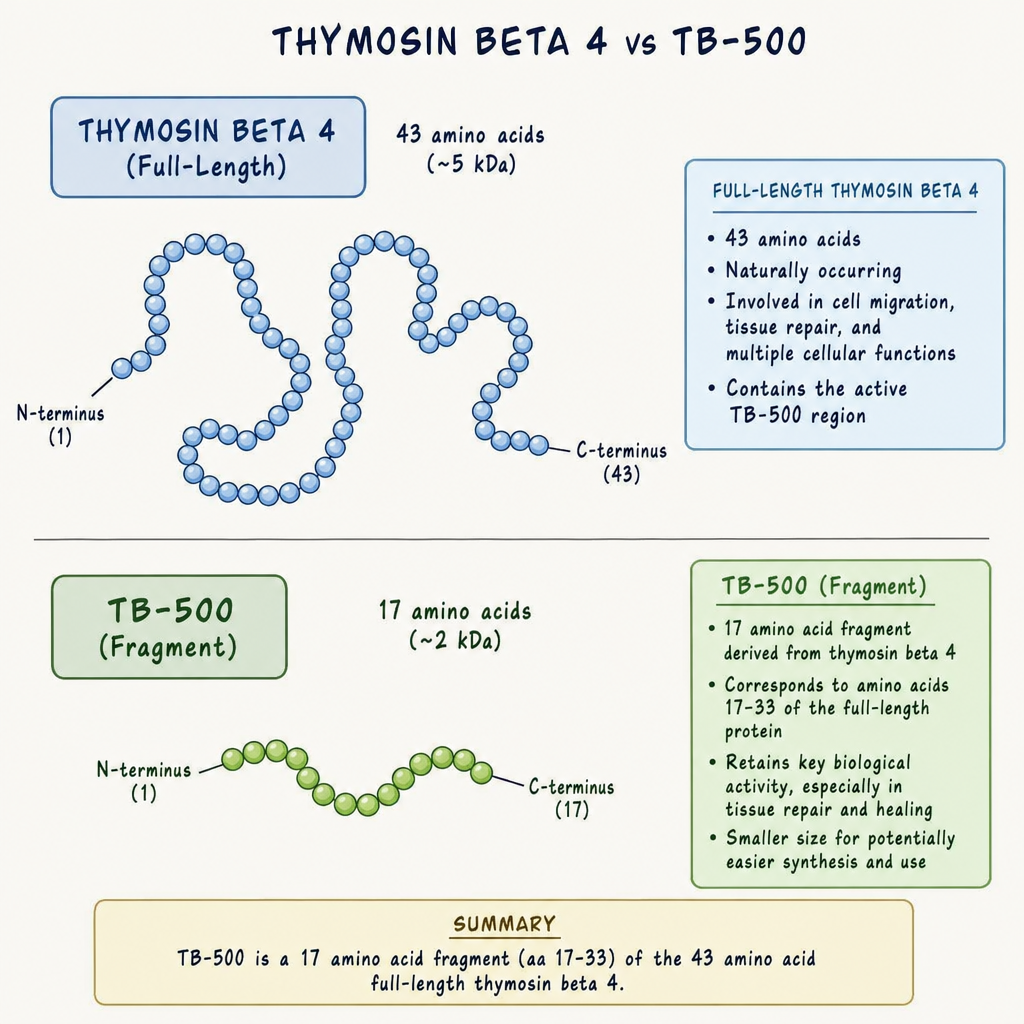
TB-500 thymosin beta 4 usually refers to a synthetic peptide marketed in the wellness, bodybuilding, and recovery communities as being related to thymosin beta 4. Full-length thymosin beta 4 is a naturally occurring 43-amino-acid peptide found in many tissues, while FDA briefing materials describe TB-500 as a synthetic fragment of thymosin beta 4. That distinction matters because a fragment is not automatically equivalent to the full peptide in the body. (fda.gov)
In practical terms, thymosin beta 4 tb 500 discussions often mix together three different things: the body's own thymosin beta 4, full-length synthetic thymosin beta 4 used in some research settings, and commercial "TB-500" products that may be fragments, salts, derivatives, or inconsistently labeled materials. When these are treated as interchangeable, benefits can be overstated and risk can be understated.
The Science Behind Thymosin Beta 4
Thymosin beta 4 has been studied for roles that are relevant to tissue repair, especially cell migration, angiogenesis, inflammation modulation, and wound-healing pathways. PubMed-indexed research includes animal wound models and clinical work involving full-length thymosin beta 4 in areas such as dermal wounds and venous ulcers. These studies help explain why the peptide attracted interest, but they do not prove that every product sold as TB-500 will deliver the same outcomes. (pubmed.ncbi.nlm.nih.gov)
One reason the research is compelling is that tissue repair is not a single action. Healing involves immune signaling, new blood vessel formation, matrix remodeling, and coordinated movement of cells into damaged areas. Thymosin beta 4 appears to interact with several of these processes, which is why researchers have explored it in skin, corneal, and organ-injury contexts. (pubmed.ncbi.nlm.nih.gov)
The practical takeaway is cautious optimism, not certainty. A biological mechanism can justify more research, but it does not replace controlled human trials, approved manufacturing standards, or clinician-guided treatment decisions.
Thymosin Beta 4 vs TB-500
The thymosin beta 4 vs TB 500 comparison begins with identity. Thymosin beta 4 is the full peptide, while TB-500 is commonly described by regulators and chemical references as a shorter synthetic fragment related to thymosin beta 4. Because size, sequence, stability, formulation, and route of administration can change biological behavior, tb 500 vs thymosin beta 4 is not just a naming debate. (fda.gov)
Here is the easiest way to think about it:
- Thymosin beta 4: the full-length peptide studied in much of the wound-healing and tissue-repair literature.
- TB-500: a synthetic fragment or related product name often used commercially, sometimes imprecisely.
- Evidence gap: findings from thymosin beta 4 research may suggest possible mechanisms, but they should not be treated as direct proof for TB-500 products.
- Labeling concern: product names may not clearly tell you whether a vial contains full-length thymosin beta 4, a fragment, a salt form, or another derivative.
This is why "thymosin beta 4 vs tb 500" is one of the most important searches a reader can make before going deeper. If the molecule is different, the evidence may be different too.
Potential TB-500 Benefits Discussed in Research
The most commonly discussed tb 500 benefits include support for tissue repair, tendon and ligament recovery, muscle healing, inflammation balance, and mobility after injury. These claims are popular because they line up with what thymosin beta 4 has been studied for: cell migration, wound repair, and tissue remodeling. However, the stronger evidence generally relates to thymosin beta 4 research, not necessarily to the TB-500 fragment sold online.
Potential areas of interest include:
- Soft-tissue repair pathways: Thymosin beta 4 research has explored wound repair, including effects on cell migration and new blood vessel formation. This is the root of many recovery claims, but it does not confirm that self-directed TB-500 use repairs tendons, ligaments, or muscles.
- Inflammation-related signaling: Some thymosin beta 4 literature discusses anti-inflammatory activity. In real-world terms, inflammation is part of healing, so "reducing inflammation" is not always automatically beneficial. Timing, tissue type, injury severity, and medical context all matter.
- Skin and dermal healing research: Clinical and preclinical work has examined thymosin beta 4 in wound settings, including venous ulcers and severe dermal injury contexts. These are medically specific situations, not general proof of faster recovery for healthy athletes or casual users. (pubmed.ncbi.nlm.nih.gov)
- Recovery interest among athletes: Athletes may be drawn to TB-500 because of claims around connective tissue and training recovery. Yet WADA's prohibited list includes thymosin beta 4 and derivatives such as TB-500, meaning competitive athletes should treat it as banned unless they have authoritative sport-specific guidance. (wada-ama.org)
Is There an Approved TB-500 Dosage?
There is no FDA-approved tb 500 dosage for injury recovery, wound healing, performance, or general wellness. FDA materials have identified no human exposure data for drug products containing the thymosin beta 4 fragment known as TB-500, and the agency has not established an approved dosing schedule for this use. That means online dose charts should not be confused with medical standards. (fda.gov)
This point is especially important because peptides are often discussed online with a false sense of precision. A forum post may mention milligrams, cycle length, or injection frequency, but that does not mean the regimen was tested for safety, purity, sterility, or long-term outcomes. Without approved labeling, there is also no standardized way to account for age, body size, medications, pregnancy status, autoimmune conditions, cancer history, wound type, or infection risk.
If someone is considering any peptide therapy, the safer path is to speak with a licensed healthcare professional who can evaluate the underlying issue first. Pain, slow healing, or recurring soft-tissue injury may reflect training load, nutrition, sleep, biomechanical stress, inflammatory disease, diabetes, medication effects, or an injury that needs imaging and conventional care.
Safety and Regulatory Considerations
The safety conversation around tb 500 thymosin beta 4 should start with uncertainty. FDA has raised concerns around some compounded peptide substances, including the potential for immunogenicity with certain routes of administration and limited human exposure data for the TB-500 fragment. Unapproved injectable products also introduce practical risks such as contamination, incorrect concentration, mislabeling, and non-sterile handling. (fda.gov)
For athletes, the regulatory issue is even clearer. WADA lists thymosin beta 4 and derivatives, including TB-500, as prohibited, and the 2026 prohibited list took effect on January 1, 2026. A supplement-style label or "research use only" disclaimer does not remove anti-doping risk. (wada-ama.org)
Before taking any claim seriously, use this checklist:
- Confirm the molecule: Is it full-length thymosin beta 4, TB-500 fragment, or something else?
- Check the evidence: Are claims based on human studies of the same molecule, or on animal and mechanistic research?
- Look for regulatory status: Is it approved for the claimed use, or only marketed as a research material?
- Consider sport rules: Competitive athletes should verify anti-doping status before exposure.
- Avoid self-injection decisions: Sterility, dose accuracy, and adverse reactions are medical concerns, not DIY details.
- Investigate the real problem: Chronic pain or poor healing deserves diagnosis, not just a recovery shortcut.
How to Read TB-500 Claims With a Critical Eye
Marketing around thymosin beta 4 tb 500 often sounds confident because it blends real scientific language with unproven consumer claims. Words like "regeneration," "repair," and "healing" may be based on legitimate research themes, but they can become misleading when applied to unapproved products or personal dosing protocols.
A good rule is to ask, "What exact molecule was studied, in whom, by what route, and for what outcome?" If the study used full-length thymosin beta 4 in a controlled wound setting, it cannot automatically prove that a commercially purchased TB-500 fragment will help a tendon strain. If the claim comes from a testimonial, remember that pain and recovery fluctuate naturally, especially when rest, rehab, sleep, and training changes happen at the same time.
Practical Takeaway
TB-500 is best understood as a research-related peptide connected to thymosin beta 4, not as a proven recovery drug. The possible benefits are interesting because thymosin beta 4 has been studied in tissue-repair biology, but the tb 500 vs thymosin beta 4 distinction is essential: a fragment is not the same as the full peptide, and evidence does not transfer automatically.
If you are researching tb 500 benefits, keep the focus on accuracy and safety. Look for molecule-specific evidence, avoid treating online tb 500 dosage advice as medical guidance, and speak with a qualified clinician about injuries, wounds, or chronic recovery problems. The most practical position is balanced: the science is worth watching, but the claims should stay within the limits of the evidence.
Related Tissue Repair / Healing Peptides
- BPC-157 — Body Protection Compound for tendon, muscle, and gut healing
- GHK-Cu — Copper peptide for skin repair, collagen support, and wound healing
- SS-31 — Mitochondrial peptide for cellular protection
- Thymosin Alpha-1 — Immune-modulating peptide
Key Research Papers on TB-500 Thymosin Beta 4: Benefits, Risks & Dosage
The following peer-reviewed studies and clinical trials are indexed in our research library for TB-500 Thymosin Beta 4: Benefits, Risks & Dosage. Each paper links to a detailed summary with key findings, study design, and publication metadata.
- Doping control analysis of TB-500, a synthetic version of an active region of thymosin β₄, in equine urine and plasma by liquid chromatography-mass spectrometry — J Chromatogr A, 2012 (280 citations)
- Synthesis and characterization of the N-terminal acetylated 17-23 fragment of thymosin beta 4 identified in TB-500, a product suspected to possess doping potential — Drug Test Anal, 2012 (280 citations)
- Simultaneous quantification of TB-500 and its metabolites in in-vitro experiments and rats by UHPLC-Q-Exactive orbitrap MS/MS and their screening by wound healing activities in-vitro — J Chromatogr B Analyt Technol Biomed Life Sci, 2024 (40 citations)
Related Tissue repair / Healing Peptides
Other peptides in the tissue repair / healing category that may be of interest for comparative research:
Vendor Price Comparison
| Product | Vendor | Size | Price | $/mg | Purity | COA | Stock | Visit |
|---|---|---|---|---|---|---|---|---|
| TB-500 10mg | 10.0mg | $54.00 | $5.40 | 99.8% | SideChain Analytics (HPLC-MS/MS) (1d) | In Stock | Visit | |
| TB-500 | 10.0mg | $65.00 | $6.50 | 99% | Third-party | In Stock | Visit | |
| TB-500 | 5.0mg | $35.00 | $7.00 | 99% | Third-party | In Stock | Visit | |
| TB-500 5mg | 5.0mg | $69.00 | $13.80 | 99%+ | — | In Stock | Visit | |
| TB-500 5mg | 5.0mg | $78.00 | $15.60 | 99%+ | Janoshik (7d) | In Stock | Visit |
Write a Review
Login to write a review
You need an account to share your experience with TB-500 Thymosin Beta 4: Benefits, Risks & Dosage.
S'inscrireRating Breakdown
Based on 2 avis.
Avis
Years of joint pain from sports. TB-500 over 8 weeks reduced inflammation dramatically. Range of motion improved significantly. No side effects. The cardiac repair potential is a bonus.
Used TB-500 after a muscle tear. Recovery time cut in half. Less inflammation and stiffness. Stacked with BPC-157 for synergistic effect. Worth it for serious injuries.
Community Discussions on TB-500
Join the conversation in our peptide community forum. Real users share their tb-500 experiences, dosing schedules, results, and tips.
View all TB-500 forum discussions