
How to Reconstitute Semaglutide
Learn the safe way to reconstitute semaglutide with this comprehensive guide on dosing, bac water measurement, and peptide usage essentials.
Overview
Semaglutide should only be reconstituted when a licensed prescriber and pharmacy have supplied a vial that specifically requires reconstitution and has clear written directions. FDA-approved semaglutide products such as Wegovy and Ozempic are supplied in manufacturer-controlled dosage forms rather than as loose powder for at-home mixing, and the FDA has warned about dosing errors with compounded injectable semaglutide products, especially when patients must measure from multidose vials. (fda.gov)
This guide explains the safe decision process, the basic math behind concentration, and the questions to ask before you reconstitute semaglutide. It is not a substitute for your prescription label, pharmacy instructions, or medical care. You can use our semaglutide dosage calculator → to check your concentration and dose-volume math after your pharmacy has confirmed the details.
What should you confirm before you reconstitute semaglutide?
Before you reconstitute semaglutide, confirm that the vial came from a licensed pharmacy, that your prescriber intended you to use a reconstituted injectable product, and that you have written instructions for the exact vial strength, diluent volume, storage time, and dose in milligrams and milliliters. If any of those details are missing, do not guess; dosing mistakes have led some patients to seek medical attention or require hospitalization, according to the FDA. (fda.gov)
Use this quick safety checklist before you start:
- You know the total milligrams in the vial and the final total milliliters after mixing.
- You have been told your semaglutide dose in milligrams, not only "units."
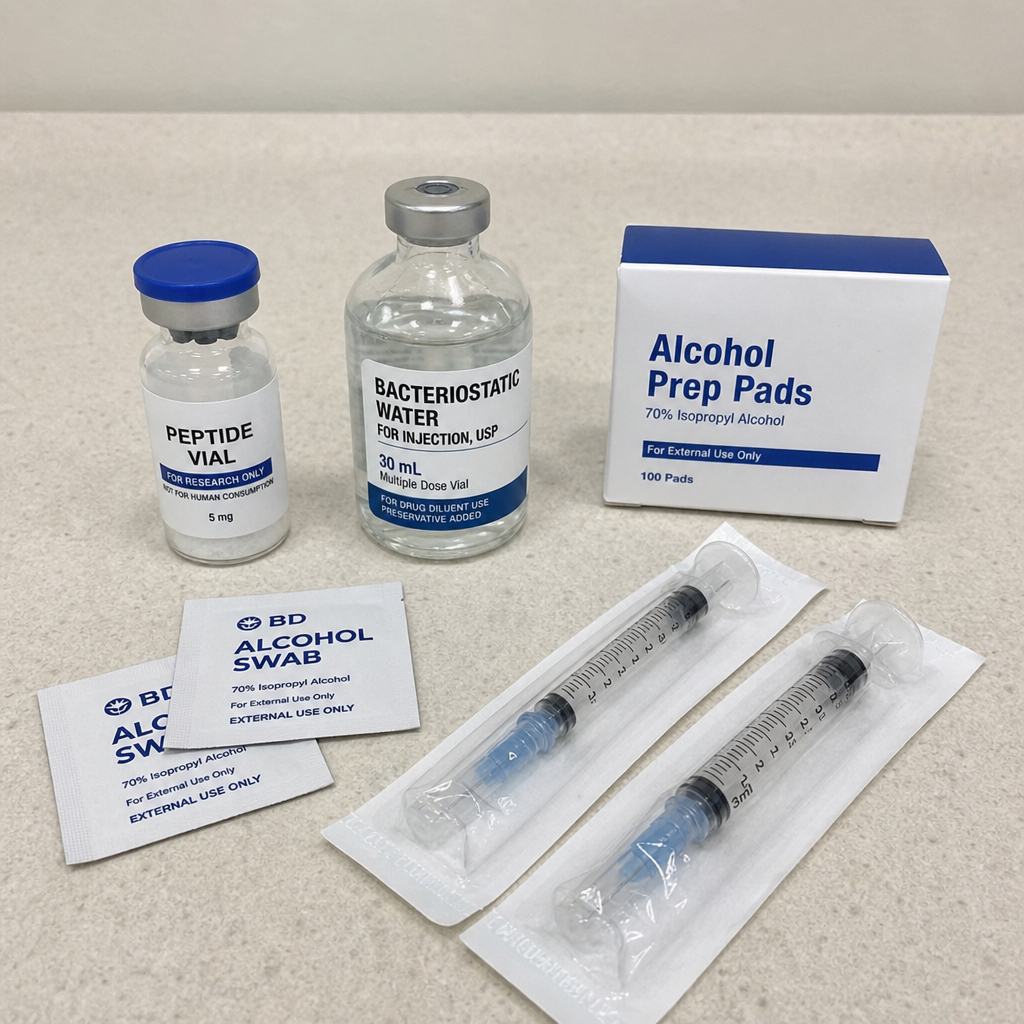
- You have sterile syringes, alcohol swabs, sharps disposal, and storage instructions.
- You know who to call if the vial looks cloudy, particles appear, the math does not match, or you feel unwell.
Use pharmacy instructions as the source of truth
The safest answer to "how much bac water for semaglutide" is: the amount printed on your pharmacy instructions. "Bac water" means bacteriostatic water, but it is not automatically appropriate for every vial, every patient, or every beyond-use date. The pharmacy's reconstitution volume determines the final concentration, which determines how many milliliters you draw for each semaglutide dosage.
Rely on a generic semaglutide dosage calculator. Calculators can be wrong for your vial if they assume a different vial strength, final concentration, syringe type, or semaglutide dosing schedule. The FDA has specifically noted confusion around measurement units such as milliliters, milligrams, and syringe "units" in compounded injectable semaglutide dosing errors. (fda.gov)
If your instructions are incomplete, ask the pharmacy these questions before touching the vial:
- "How many milligrams of semaglutide are in this vial?"
- "Exactly how many milliliters of diluent should I add?"
- "What will the final concentration be in mg/mL?"
- "What is my semaglutide dose in mg, and what is that in mL for this vial?"
- "How should I store the mixed vial, and when must I discard it?"
- "Which syringe should I use, and how do the markings correspond to mL?"
1. Prepare a clean, organized work area
Start by washing your hands well and clearing a flat surface. Good organization lowers the chance of contaminating the vial, grabbing the wrong syringe, or mixing up the diluent volume. Keep pets, food, drinks, and clutter away from the area while you work.
Place your supplies where you can see each label. You may need the semaglutide vial, the prescribed diluent, a sterile syringe for reconstitution, a separate injection syringe if instructed, alcohol swabs, gauze, your written instructions, and a sharps container. If the medication or diluent label does not match what your pharmacy told you, stop and call before continuing.
Do not use a vial that is cracked, leaking, unlabeled, expired, or suspicious. Do not use powder or liquid purchased from an unverified online seller.
2. Inspect the vial and diluent before mixing
Look at the semaglutide vial without shaking it. Some pharmacy-prepared vials may contain a dry powder or cake; others may already be supplied as a liquid. If your vial is already liquid, do not add bacteriostatic water unless the pharmacy specifically instructed you to do so.
Inspect the diluent in the same way. It should match the name and volume listed in your instructions. If it appears discolored, contains floating particles, or has a damaged seal, do not use it.
This step matters because reconstitution changes the concentration. Adding too much diluent can make each milliliter weaker; adding too little can make each milliliter stronger. Either mistake can make your semaglutide dosage in ml different from what your prescriber intended.
3. Calculate the final concentration before drawing anything
Before mixing, write down the concentration you expect after reconstitution. A semaglutide dosage calculator → can help with this math, but you still need the pharmacy-confirmed values. The basic formula is:
Total semaglutide in vial / total final volume = concentration in mg/mL
For example, if a vial contained 5 mg total and the pharmacy directed you to add enough diluent to make 2 mL final volume, the final concentration would be 2.5 mg/mL. This is only an example of the math, not a recommended semaglutide dose or mixing instruction.
To convert a prescribed dose into milliliters, use:
Prescribed dose in mg / concentration in mg/mL = volume to inject in mL
For example, with a 2.5 mg/mL concentration, a 0.25 mg dose would equal 0.1 mL. Again, this is a calculation example only. Your actual semaglutide dosage, concentration, and semaglutide dosage in ml must come from your prescription and pharmacy label.
4. Add only the directed amount of diluent
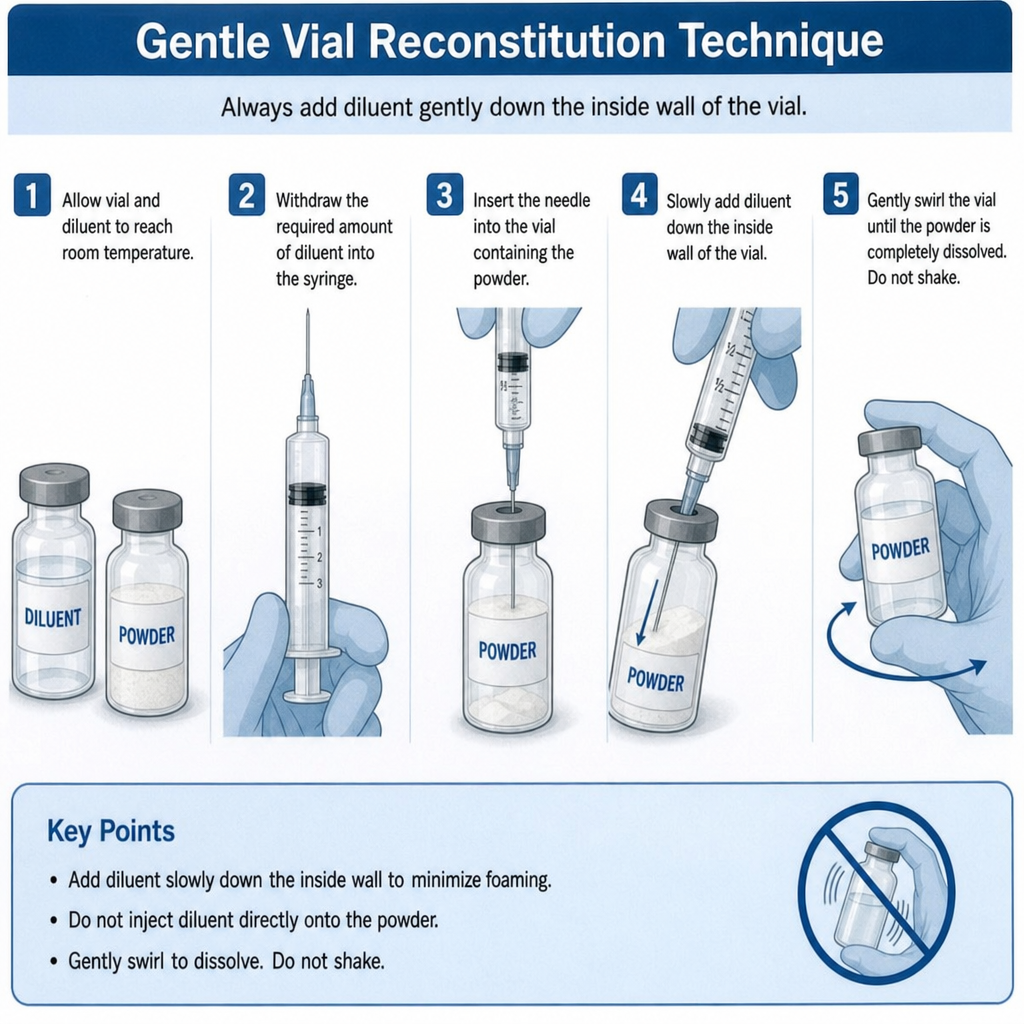
Clean the vial stoppers with alcohol and let them dry. Draw up only the amount of diluent your pharmacy specified. Inject it slowly into the semaglutide vial, aiming the stream toward the inside wall rather than blasting directly into the powder.
Do not improvise the amount of bacteriostatic water. The question "how much bac water for semaglutide" has no universal answer because a 2 mg vial, 5 mg vial, and 10 mg vial can all require different directions depending on the intended final concentration. The same semaglutide dose in milligrams can require a different volume in milliliters if the vial was mixed to a different concentration.
Avoid touching the needle, vial stopper after cleaning, or any sterile surfaces. If you drop the syringe, contaminate the needle, or lose track of how much diluent you added, stop and contact the pharmacy. Starting over safely is better than injecting an uncertain concentration.
5. Dissolve the medication gently
After adding the diluent, gently swirl or roll the vial as directed until the contents dissolve. Do not shake vigorously unless your pharmacy explicitly tells you to. Forceful shaking can create bubbles and may make it harder to measure an accurate dose.
Once mixed, inspect the solution again. It should match the appearance described by the pharmacy. If it remains cloudy, contains particles, changes color, foams excessively, or does not dissolve as expected, do not inject it.
This is also the point to label the vial if your pharmacy provided a reconstitution label. Write the mixing date, discard date, and concentration only if instructed. Clear labeling helps prevent the most common problem with compounded semaglutide dosing: forgetting what strength the vial is after it has been mixed.
6. Convert your prescribed semaglutide dose into the correct volume
Your semaglutide dose should be written in milligrams. The volume you inject should be written in milliliters for your exact concentration. If your instructions only say "inject 10 units" or "inject 20 units," ask the pharmacy to translate that into mg and mL for your syringe.
This distinction is important because "units" are markings on certain insulin-style syringes, not a universal drug dose. One person's 10 units may represent a different semaglutide dosage than another person's 10 units if their vials were mixed to different concentrations. FDA and professional safety discussions have highlighted this exact type of confusion with compounded GLP-1 products. (fda.gov)
If you are using our semaglutide dosage calculator →, check that it asks for vial strength, diluent volume, and intended dose. A calculator that skips any of those inputs cannot safely calculate semaglutide dosage in ml. If the calculator result disagrees with your label, do not split the difference. Call your pharmacist and ask them to walk through the calculation with you.
7. Draw the dose slowly and check the syringe twice
Clean the vial stopper again, use a new sterile syringe, and draw the prescribed volume slowly. Remove air bubbles according to your pharmacy's instructions, then check the syringe marking at eye level. Tiny volume differences can matter when the medication is concentrated.
Before injecting, compare three things: the medication name, the prescribed semaglutide dose in mg, and the volume in mL. If the syringe marking does not make sense, pause. Many dosing errors happen not because the patient ignores instructions, but because the label, vial, and syringe use different measurement language.
Never draw extra medication "just in case," and never combine leftover amounts from different vials unless your pharmacist specifically instructs you. Different vials may have different concentrations, storage times, or beyond-use dates.
8. Store the reconstituted vial exactly as directed
After reconstitution, storage instructions matter. Follow the temperature, light protection, and discard date on your pharmacy label. Do not assume that every compounded or reconstituted semaglutide vial has the same stability period.
Keep the vial away from children and from anyone who may confuse it with another injectable medication. Store syringes and sharps safely. If the vial freezes, overheats, is left out longer than instructed, or looks different later, ask the pharmacy whether it should be discarded.
Also keep a simple medication log. Record the date, dose in mg, volume in mL, injection site if applicable, and any side effects. This helps your prescriber evaluate tolerability before changing semaglutide dosing.
How do semaglutide starting dose and titration usually work?
A semaglutide starting dose is usually intentionally low, then increased gradually only when clinically appropriate. For FDA-approved Wegovy injection, the labeled dose-escalation schedule begins at 0.25 mg once weekly and increases over time toward maintenance dosing; Ozempic labeling also uses gradual initiation and escalation for type 2 diabetes treatment. Your personal semaglutide dosing plan may differ based on the product, diagnosis, tolerability, other medications, and clinician judgment. (accessdata.fda.gov)
Do not increase your dose because you want faster results, because a friend uses a higher amount, or because an online chart suggests it. More medication is not automatically better, and rapid escalation can increase side effects. If nausea, vomiting, diarrhea, dehydration symptoms, severe abdominal pain, or signs of allergic reaction occur, contact a healthcare professional promptly or seek urgent care when symptoms are severe.
Learn how to take semaglutide safely from your care team
The safest way to learn how to take semaglutide is to have your prescriber or pharmacist demonstrate the exact product you received. Ask them to watch you draw a practice dose using the correct syringe and to confirm how your semaglutide dosage in ml appears on that syringe. This is especially useful if you are new to injections or if your vial label includes both mg and "units."
Bring these items to your teaching visit or pharmacy consultation:
- Your vial and diluent, still unopened if possible.
- The syringe type you were given.
- Your written dosing instructions.
- A list of other medications and supplements.
- Questions about missed doses, side effects, storage, travel, and disposal.
Semaglutide can be helpful when prescribed and monitored appropriately, but reconstitution adds room for error. If you are unsure how to reconstitute semaglutide, how much bacteriostatic water to use, or how to calculate your dose, do not proceed by trial and error. Call the pharmacy, ask your clinician, and use only the dose and volume they confirm for your specific vial.
Related Peptides
References
- FDA. FDA Alerts Health Care Providers, Compounders, and Patients about Dosing Errors Associated with Compounded Injectable Semaglutide. fda.gov
- FDA. Wegovy (semaglutide) Injection Label. accessdata.fda.gov
- FDA. Ozempic (semaglutide) Injection Label. accessdata.fda.gov