
How to Reconstitute Retatrutide
Learn the proper way to reconstitute retatrutide safely with this comprehensive guide. Understand the crucial steps, dosage calculations, and the importance of professional supervision.
Overview
Retatrutide reconstitution is the process of adding a sterile diluent to a lyophilized retatrutide vial so the concentration can be calculated before any measured dose is drawn. This guide explains the safety checks, basic reconstitution workflow, and dose-volume math people often mean when they search for how to reconstitute retatrutide, retatrutide dosage in ml, or a retatrutide dosage calculator →. It is for education only: retatrutide is not FDA-approved and should only be handled or used under an authorized clinical protocol or licensed medical supervision.
Is retatrutide reconstitution something you should do yourself?
No, not unless you have been specifically instructed and trained by a qualified clinician, study site, or pharmacy. Lilly states that retatrutide is investigational, not FDA-approved, and legally available only through Lilly clinical trials; the FDA also warns that unapproved GLP-1 products have not undergone FDA review for safety, effectiveness, or quality before marketing.
That matters because reconstitution is not just "adding water." A small math error, contaminated needle, mislabeled vial, or unclear concentration can change the retatrutide dose delivered. The FDA has reported adverse events with compounded injectable GLP-1 products involving measurement and self-administration errors, including cases requiring medical attention.
What you need before you start
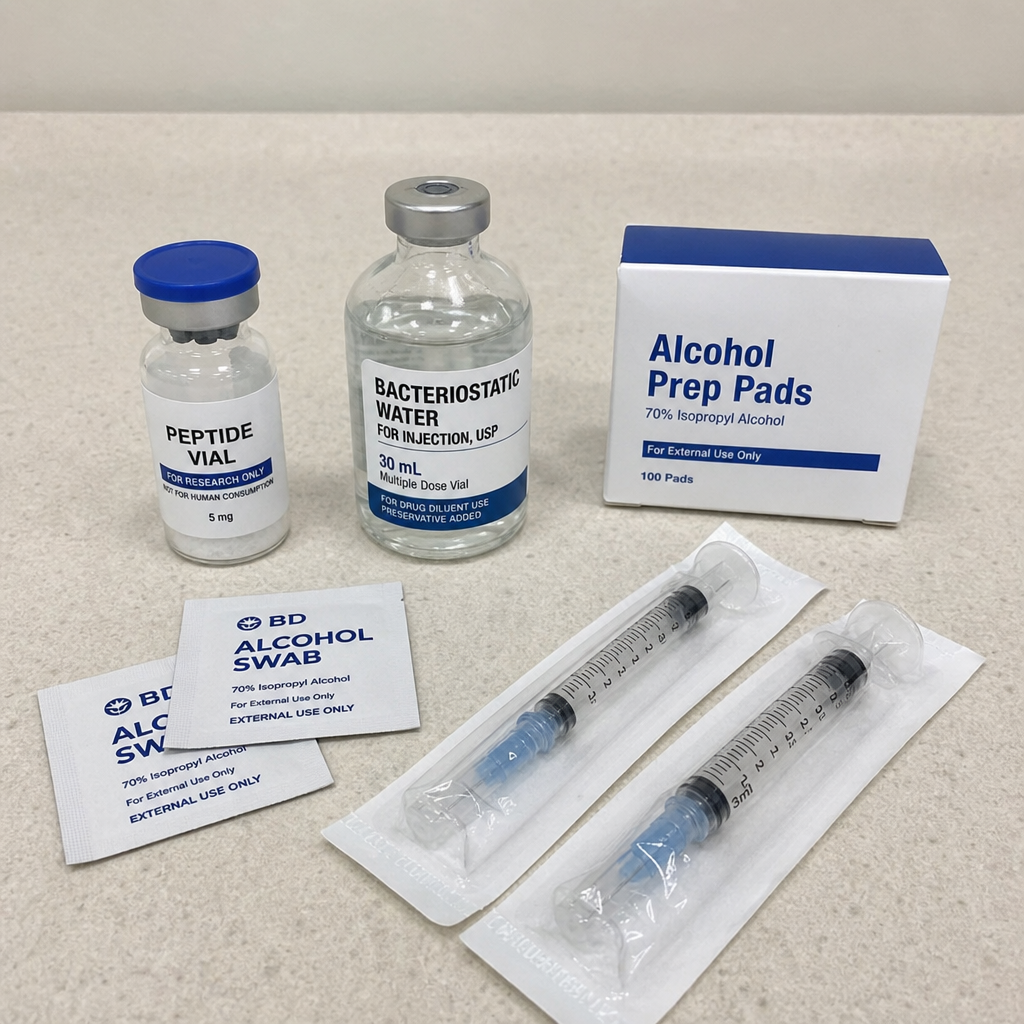
Before any sterile medication is prepared, you need a clean preparation area, sterile single-use syringes and needles, alcohol wipes, clear labeling, and the exact written instructions from the manufacturer, trial protocol, prescriber, or pharmacist. Bacteriostatic Water for Injection is a sterile diluent that contains benzyl alcohol as a preservative and is supplied for diluting or dissolving drugs for injection according to the drug manufacturer's instructions.
Do not improvise with tap water, drinking water, nonsterile saline, or a diluent that was not specified for the product. DailyMed labeling also notes that bacteriostatic water is not for use in neonates and that clinicians should consult manufacturer instructions for the correct vehicle, dilution volume, route, and rate.
Use this checklist before proceeding:
- Confirm the vial identity, strength, lot number, and beyond-use or expiration date.
- Confirm the exact diluent and volume in the written instructions.
- Use a new sterile syringe and needle every time a vial is entered.
- Wipe vial stoppers with alcohol and let them dry.
- Work on a disinfected surface away from sinks, food, pets, and clutter.
- Stop if the powder, liquid, stopper, or vial looks damaged, discolored, cloudy, or contaminated.
1. Verify that the vial and instructions match
Start by reading the retatrutide vial label and the written directions from the source that is legally responsible for the medication. You are looking for the vial strength in milligrams, the approved or protocol-specified diluent, the amount of diluent to add, storage instructions, and any beyond-use limit after mixing. If any of those details are missing, do not guess.
This is the step that prevents most downstream dosing confusion. A "10 mg vial" tells you the total amount of retatrutide in the vial, not the dose you should take and not the milliliters to inject. The retatrutide dosage in ml can only be calculated after you know how many milliliters of diluent were added.
2. Prepare a clean, aseptic workspace
Wash your hands, disinfect the work surface, and place only the needed sterile supplies in the area. CDC safe injection guidance emphasizes aseptic technique, sterile single-use needles and syringes, and avoiding contamination of medication vials.
Keep the setup simple. Open sterile packaging only when you are ready to use it, and never lay an uncapped needle on the table. If a needle touches a nonsterile surface, discard it and use a new one.
3. Inspect both vials before mixing
Look at the retatrutide vial and the bacteriostatic water vial before puncturing either stopper. The retatrutide powder should not be used if the vial is cracked, leaking, unlabeled, or visibly contaminated. The diluent should also be clear, in-date, and stored according to its label.
DailyMed labeling for bacteriostatic water advises inspecting reconstituted drugs for clarity and freedom from unexpected discoloration or precipitation when the solution and container allow. That same practical rule applies before mixing: if something looks wrong, stop and ask a pharmacist or clinician.
4. Clean the stoppers and draw the diluent
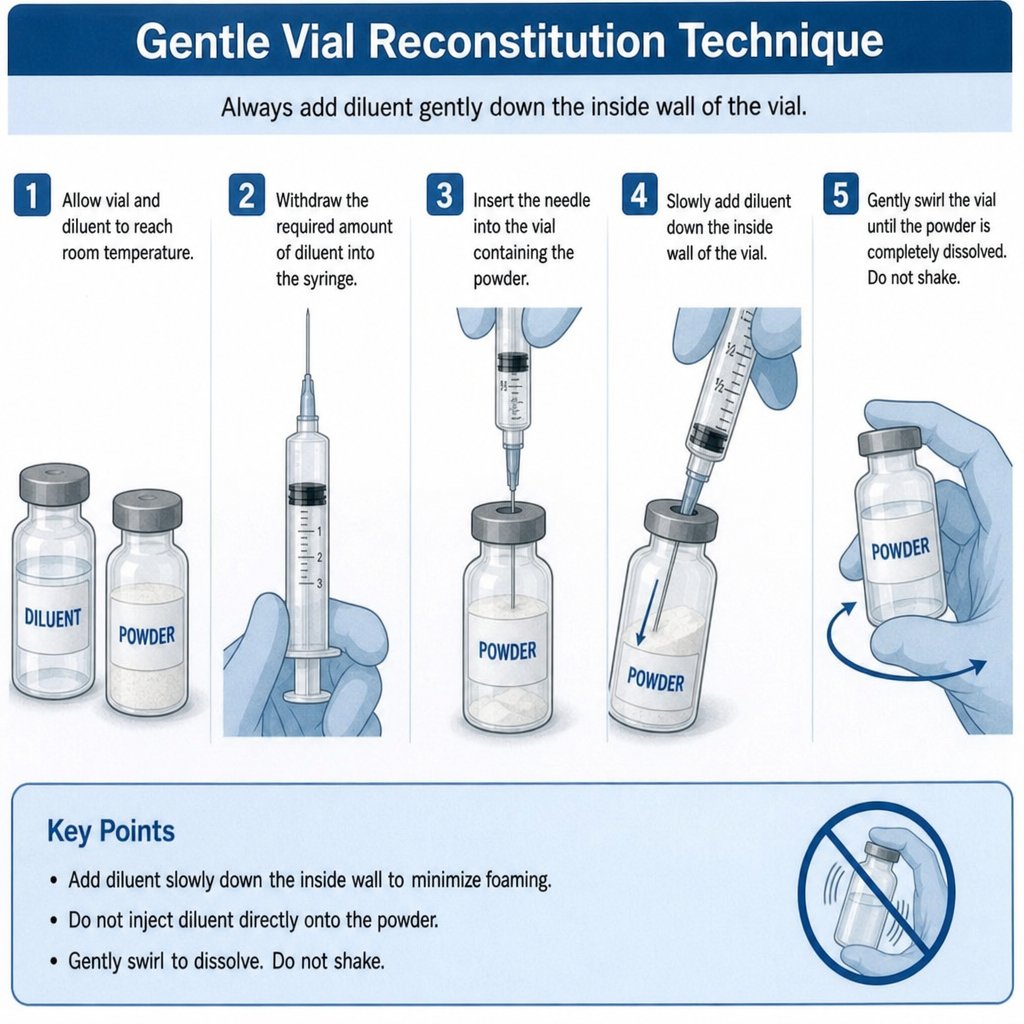
Wipe the rubber stopper of each vial with a fresh alcohol swab and allow it to dry. Draw the exact amount of bacteriostatic water specified in the written instructions. Do not round the volume because the added volume determines the final concentration.
For example, people often ask how much bac water for 10mg retatrutide. The safest answer is: use only the amount specified by the clinical protocol, pharmacy, or manufacturer. If no valid instruction is provided, the vial should not be mixed for use.
5. Add the diluent gently
Insert the needle into the retatrutide vial and slowly add the diluent along the inside wall of the vial rather than forcefully blasting the powder. The purpose is to dissolve the powder while minimizing foaming, splashing, or unnecessary agitation. Once the liquid is in the vial, remove the needle safely and discard it in an appropriate sharps container.
Do not shake the vial vigorously. If the product instructions allow it, gently swirl or roll the vial until the powder is dissolved. If particles remain, the liquid becomes unexpectedly cloudy, or the color changes, do not use it.
6. Calculate the concentration before drawing any dose
This is where a retatrutide dosage calculator → is useful, but the calculator is only doing simple concentration math. The formula is:
- Concentration in mg/mL: total vial amount in mg divided by total diluent added in mL.
- Dose volume in mL: intended dose in mg divided by concentration in mg/mL.
- U-100 syringe units: dose volume in mL multiplied by 100.
Here is a non-prescriptive example for a 10 mg vial:
- If 1 mL diluent is added to 10 mg, the concentration is 10 mg/mL.
- If 2 mL diluent is added to 10 mg, the concentration is 5 mg/mL.
- A smaller diluent volume creates a more concentrated solution, so fewer mL are drawn for the same mg amount.
- A larger diluent volume creates a less concentrated solution, so more mL are drawn for the same mg amount.
This example does not mean either volume is right for you. It only shows how the math works after an authorized instruction tells you what concentration to prepare.
7. Convert the retatrutide dose to mL carefully
A retatrutide dose is usually discussed in milligrams, while syringes measure volume. That is why "retatrutide dosage" and "retatrutide dosage in ml" are not interchangeable. You must know the concentration first.
Using the same 10 mg vial examples:
- At 10 mg/mL, a 1 mg dose would equal 0.1 mL, or 10 units on a U-100 insulin syringe.
- At 10 mg/mL, a 2 mg dose would equal 0.2 mL, or 20 U-100 units.
- At 5 mg/mL, a 1 mg dose would equal 0.2 mL, or 20 U-100 units.
- At 5 mg/mL, a 2 mg dose would equal 0.4 mL, or 40 U-100 units.
The retatrutide dose used in clinical research should not be copied into self-treatment. In a phase 2 obesity trial, researchers studied once-weekly retatrutide doses including 1 mg, 4 mg, 8 mg, and 12 mg under controlled trial conditions, with safety monitoring and defined escalation regimens.
8. Label and store the mixed vial correctly
After reconstitution, label the vial with the concentration, date mixed, diluent amount, and any beyond-use date supplied by the pharmacist, protocol, or manufacturer. Do not rely on memory, especially if more than one vial, syringe size, or concentration is present. A clear label helps prevent drawing the wrong volume later.
Storage should follow the specific instructions for the product and source. If the instructions are missing, conflicting, or copied from an online forum, do not treat them as reliable. Unapproved products may have unknown purity, potency, sterility, or stability, which is one reason FDA and Lilly warn against consumer use outside authorized pathways.
9. Draw a dose only from a known concentration
If a clinician or protocol has instructed administration, draw only the calculated volume from a vial whose concentration you can verify. Use a new sterile syringe and needle, clean the stopper again, and avoid touching sterile parts. CDC guidance says medication vials should not be entered with a syringe or needle that has already been used.
Never prefill syringes for later unless a qualified pharmacy or clinical protocol specifically instructs that process. CDC notes that preparing injections close to the time of administration reduces risks related to sterility and stability.
How do you avoid common retatrutide dosing mistakes?
The best way to avoid mistakes is to separate three ideas: vial strength, concentration, and dose volume. Vial strength is the total drug in the vial. Concentration is the mg per mL after reconstitution. Dose volume is how many mL you draw for the prescribed or protocol-directed retatrutide dose.
Common errors include:
- Treating "10 mg vial" as if it means "10 mg per mL," even when more than 1 mL was added.
- Using U-100 syringe "units" without converting units back to mL.
- Changing the amount of bacteriostatic water but continuing to draw the old volume.
- Following a retatrutide starting dose from social media instead of a supervised protocol.
- Assuming "research use" or "compounded" means FDA-reviewed.
If you are using our retatrutide dosage calculator →, check that it asks for vial strength, diluent volume, and intended dose. A calculator that skips any of those inputs cannot safely calculate retatrutide dosage in ml.
Retatrutide dosing decisions belong to a clinician
Questions about retatrutide dosing, retatrutide starting dose, how to take retatrutide, and when to increase a dose are medical decisions, not reconstitution decisions. Clinical trials use defined eligibility criteria, escalation schedules, monitoring, and adverse-event management. That environment is very different from buying an unlabeled or unapproved vial and trying to reverse-engineer a plan.
If you are considering retatrutide, talk with a licensed healthcare professional about approved alternatives, clinical trial eligibility, and the risks of unapproved GLP-1 products. If you already have a vial and are unsure how it was made, stored, shipped, or labeled, do not inject it. The safest next step is to contact a clinician or pharmacist and use only medications obtained through lawful, quality-controlled channels.
Related Peptides
References
- Lilly. What to Know About Retatrutide. lilly.com
- FDA. Medications Containing Semaglutide Marketed for Type 2 Diabetes or Weight Loss. fda.gov
- DailyMed. Bacteriostatic Water for Injection. dailymed.nlm.nih.gov
- CDC. Safe Injection Practices. cdc.gov/injection-safety
- Jastreboff AM, et al. Triple-Hormone-Receptor Agonist Retatrutide for Obesity -- A Phase 2 Trial. N Engl J Med, 2023. pubmed.ncbi.nlm.nih.gov