
How to Reconstitute IGF-1 LR3 Safely: Dosage & Steps
Learn how to safely reconstitute IGF-1 LR3, calculate dosage, and avoid common dosing errors. Understand the critical steps for IGF-1 LR3.
Overview
IGF-1 LR3 is a research growth-factor peptide, not a self-directed wellness supplement or a substitute for prescribed IGF-1 therapy. This guide explains how to think through laboratory reconstitution: checking the vial, choosing the correct solvent from the supplier's protocol, calculating concentration, mixing gently, labeling, storing, and avoiding common handling errors. It does not provide an IGF-1 LR3 dosage, IGF-1 LR3 starting dose, or instructions on how to take IGF-1 LR3 for human use. You can use our IGF-1 LR3 dosage calculator → to check your concentration and dose-volume math after your supplier has confirmed the details.
Can you reconstitute IGF-1 LR3 for personal use?
No. IGF-1 LR3 should be treated as a research-use material unless it is part of a lawful, professionally supervised protocol. Supplier documentation for Long R3 IGF-1 products describes R&D use and cell-culture preparation, not consumer dosing or at-home administration. Native recombinant IGF-1 also has clinically important glucose-lowering potential, and the FDA-labeled mecasermin product is a distinct prescription medicine with specific indications, warnings, and monitoring requirements.
That distinction matters before you touch the vial. A phrase like "IGF-1 LR3 dosage in ml" sounds simple, but milliliters only describe liquid volume; they do not establish whether a substance is appropriate, safe, sterile, compatible, or legal to use. If your actual goal is human injection, stop here and speak with a licensed medical professional rather than relying on a generic calculator or online peptide chart. If you do want to cross-check lab concentration math, use our IGF-1 LR3 dosage calculator → — but only for research concentration calculations, never for human dosing.
Prepare the workspace and confirm the vial details
Before reconstitution, make the job boring and controlled. Read the supplier's certificate of analysis, product sheet, lot number, storage instructions, and recommended solvent. Do not assume that every peptide labeled "IGF-1 LR3" should be mixed the same way, because formulation, fill amount, excipients, and intended research use can differ.
Use a clean, low-traffic work area and gather only what the protocol allows:
- The lyophilized IGF-1 LR3 research vial
- The manufacturer-specified solvent or buffer
- Sterile transfer supplies suitable for laboratory use
- Alcohol wipes or approved surface disinfectant
- Labels for concentration, solvent, date, and initials
- A sharps or biohazard disposal container, if applicable
- Cold storage or freezer space matching the product sheet
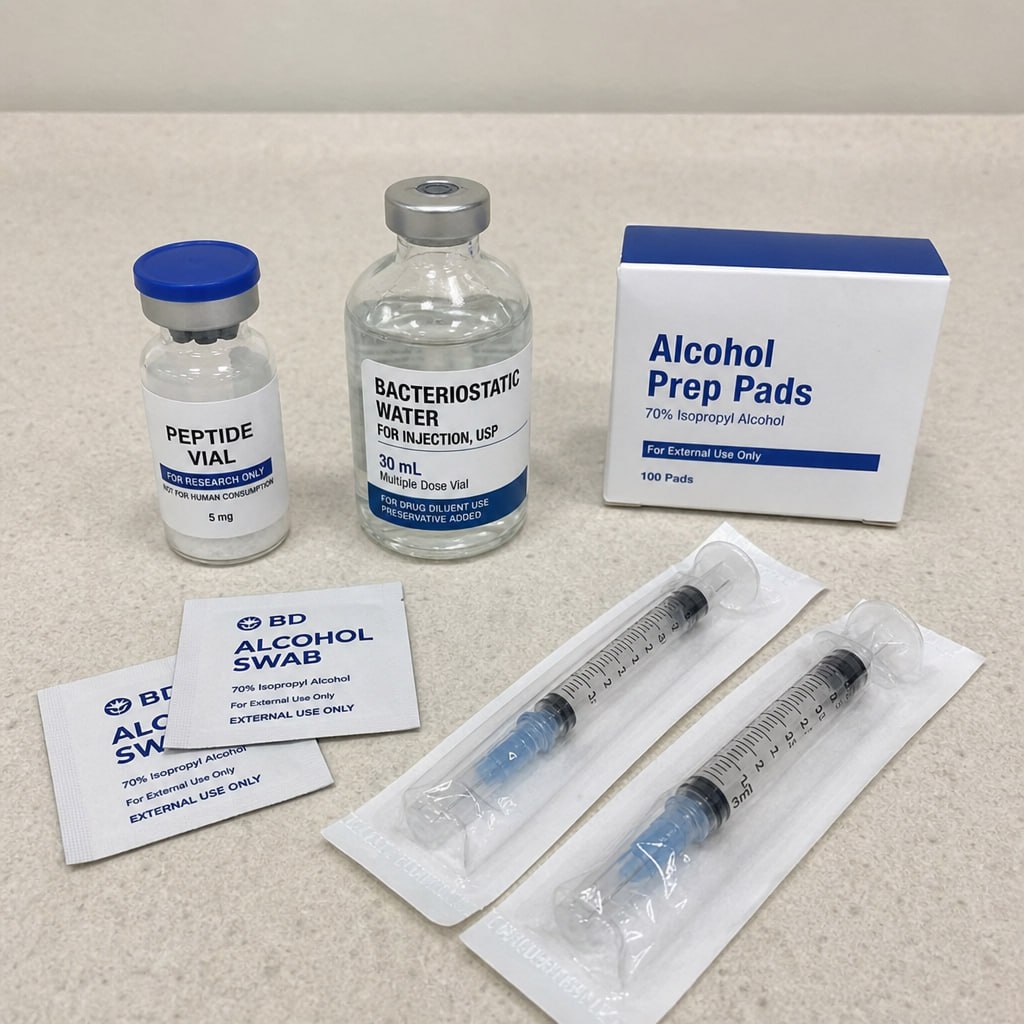
A common question is "how much bac water IGF-1 LR3 needs," sometimes misspelled as "how much buc water IGF-1 LR3." The safest answer is: use the solvent and volume specified by the supplier or validated lab protocol. Bacteriostatic Water for Injection, USP contains 0.9% benzyl alcohol and is labeled as a diluent for drugs that require dilution or dissolution according to the drug manufacturer's instructions; the label also says to use aseptic technique and not to store reconstituted drug solutions unless the solute manufacturer directs it.
1. Verify the intended research concentration
Start by deciding the final stock concentration required by your experiment, not by guessing a convenient syringe volume. In laboratory work, concentration drives repeatability. If two people add different solvent volumes to identical vials, the same visual amount of liquid will contain different amounts of peptide.
A manufacturer datasheet for one Long R3 IGF-1 product gives a specific example: prepare a 1 mg/mL stock by adding 100 uL of 10 mM HCl to the vial, then store stock solutions frozen and avoid repeated freeze-thaw cycles. That is a product-specific lab instruction, not a universal rule and not a human-use recommendation.
Use these calculations for research concentration planning:
1. Convert the vial amount to micrograms. 1 mg equals 1,000 mcg.
2. Divide total peptide by solvent volume. Concentration equals total mcg divided by total mL.
3. Calculate aliquot volume for an assay. Volume needed equals desired mcg divided by concentration in mcg/mL.
4. Record the math on the vial label or lab sheet. Include peptide amount, solvent, final volume, final concentration, and date.
This is the only appropriate role for an IGF-1 LR3 dosage calculator → in this context: lab concentration math. A calculator can help with vial-strength, diluent-volume, and target-dose calculations, but it should not be used to create an IGF-1 LR3 dose for a person.
2. Choose the solvent specified by the protocol
Do not automatically reach for bac water because a forum or product page mentions it. Some Long R3 IGF-1 research documentation uses acidic solvent conditions for stock preparation, and some protocols add carrier protein for dilute solutions to reduce loss on plastic or glass surfaces. The Sigma-Aldrich datasheet, for example, notes that when concentrations are below 1 mg/mL in buffer, a carrier protein may be used to minimize adsorption.
This step is where many reconstitution mistakes begin. Bacteriostatic water may be familiar from injectable-drug contexts, but compatibility is not guaranteed for every peptide or every experimental endpoint. The DailyMed label for Bacteriostatic Water for Injection says to consult manufacturer instructions for the vehicle, dilution volume, route, and rate of injection, and it warns that some drugs may be incompatible with a given vehicle or with benzyl alcohol.
If your supplier's sheet is missing, vague, or contradictory, do not improvise. Contact the supplier, consult your lab supervisor, or use a validated protocol from your institution. A clear protocol should tell you the solvent, final concentration, storage condition, acceptable hold time, and whether filtration or carrier protein is required.
3. Add solvent slowly down the vial wall
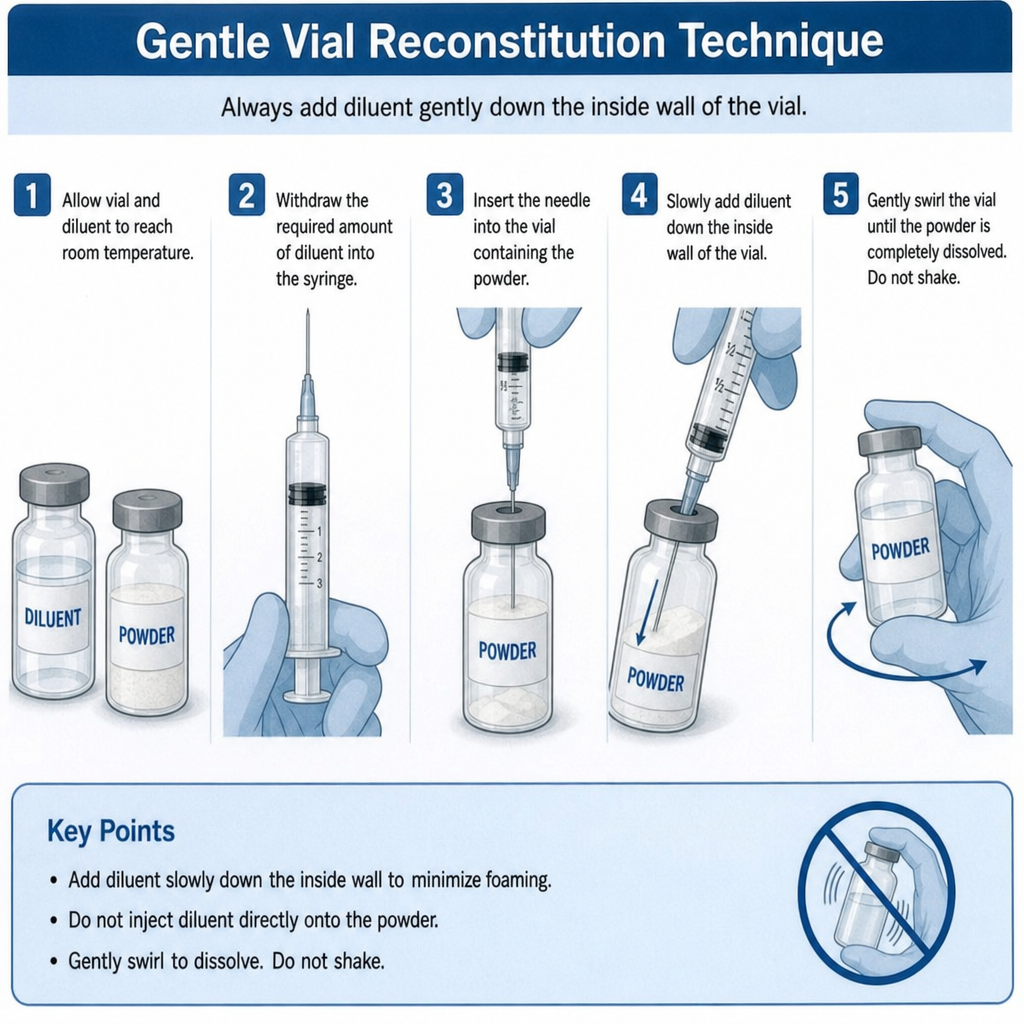
Once the solvent is confirmed, add it gently. Aim the liquid down the inner wall of the vial rather than blasting the powder directly. Lyophilized peptides can foam, cling, or denature when handled roughly, and aggressive mixing can make it harder to judge whether the material has fully dissolved.
A practical lab sequence looks like this:
1. Bring the vial and solvent to the protocol-approved working condition.
2. Inspect the vial for cracks, damaged seal, moisture, discoloration, or unexpected material.
3. Clean the stopper or opening according to lab practice.
4. Add the measured solvent slowly along the glass wall.
5. Let the vial sit briefly so the cake begins to wet evenly.
6. Gently swirl or roll the vial until dissolved.
7. Do not shake vigorously.
After mixing, inspect the solution. If the protocol says the material should be clear and it remains cloudy, stringy, unexpectedly colored, or particulate-filled, do not use it. DailyMed labeling for parenteral products emphasizes inspection for particulate matter and discoloration when solution and container permit, and the same habit is useful in controlled research handling.
4. Label the reconstituted stock immediately
A reconstituted vial without a clear label is a failed preparation, even if the math was perfect. Write the label before the vial goes into storage or leaves your bench. If multiple peptide vials are being prepared, label one at a time to prevent mix-ups.
Include:
- Compound name: IGF-1 LR3 or Long R3 IGF-1
- Lot number or internal sample ID
- Original vial amount
- Solvent used
- Final volume
- Final concentration
- Date and time reconstituted
- Storage condition
- Preparer initials
- Any "research use only" restriction
This step also helps prevent misuse of the phrase IGF-1 LR3 dosage. The number on a research vial should describe concentration for a controlled experiment, not a personal dosing instruction.
How do you calculate IGF-1 LR3 concentration in mL?
Calculate concentration by dividing the amount of peptide by the final liquid volume. For example, if a research vial contains 1,000 mcg and the validated protocol adds 1 mL of compatible solvent, the concentration is 1,000 mcg/mL. If the same vial is brought to 2 mL, the concentration becomes 500 mcg/mL.
If you are using our IGF-1 LR3 dosage calculator →, check that it asks for vial strength, diluent volume, and intended dose. A calculator that skips any of those inputs cannot safely calculate IGF-1 LR3 concentration. Use this simple lab formula:
1. Concentration: total peptide divided by total solvent volume
2. Aliquot volume: target research amount divided by concentration
3. Final record: write the result as mcg/mL or mg/mL, not just "units"
This is where searches for "IGF-1 LR3 dosage in ml" can become misleading. A milliliter value changes every time the reconstitution volume changes. Without an approved clinical product, validated protocol, and professional oversight, converting an IGF-1 LR3 dose into mL for human use is not appropriate.
5. Aliquot the stock to reduce freeze-thaw damage
If the protocol allows frozen storage, aliquoting can protect consistency. Instead of repeatedly thawing the main vial, divide the stock into small labeled portions that match planned research runs. Repeated freeze-thaw cycles are discouraged in the Long R3 IGF-1 datasheet, and dilute solutions may be less suitable for long-term storage.
Good aliquot practice is simple:
1. Decide the volume needed for each experiment before opening the stock.
2. Use sterile, low-binding tubes if the protocol calls for them.
3. Label every aliquot with compound, concentration, date, and storage condition.
4. Freeze or refrigerate according to the supplier's instructions.
5. Thaw only what you need.
6. Discard questionable or expired material according to lab policy.
Avoid making unlabeled "convenience" tubes. A tiny tube with no concentration, solvent, or date can ruin an experiment and create a safety problem for anyone else using the freezer.
6. Store it according to the product sheet
Storage is not just about keeping the vial cold. It is about preserving identity, concentration, and usability across the planned research window. One Long R3 IGF-1 product sheet lists 2-8 C storage for the lyophilized product and frozen storage for prepared stock solutions, with avoidance of repeated freeze-thaw cycles.
Keep the storage process consistent:
- Protect the vial or aliquots from unnecessary light if directed.
- Use a dedicated box or rack so tubes stay upright and findable.
- Record freezer location in the lab notebook or inventory system.
- Do not store reconstituted material longer than the supplier or protocol allows.
- Discard material after contamination, thawing errors, visible changes, or label uncertainty.
Bacteriostatic water does not make a preparation immune to contamination or chemical degradation. Its label describes benzyl alcohol as a bacteriostatic preservative, but it still requires aseptic handling and compatibility with the substance being dissolved.
7. Document the preparation before using it in an experiment
Documentation turns reconstitution from a one-off task into a repeatable method. Record the product name, supplier, lot, mass, solvent, final volume, concentration, appearance, storage location, and any deviation from the protocol. If a future result looks unusual, these notes help you determine whether the problem came from the biology, the assay, the solvent, or the handling.
A concise reconstitution record should answer:
- What was reconstituted?
- Who prepared it?
- Which solvent and volume were used?
- What concentration resulted?
- Was the solution clear or abnormal?
- How was it stored?
- Which aliquots were used and when?
This record also prevents accidental reliance on memory. "I think it was 1 mL" is not good enough when small concentration differences can affect a research outcome.
Common mistakes to avoid
The biggest mistake is treating IGF-1 LR3 like a consumer peptide with a universal recipe. It is a bioactive research material, and the correct preparation depends on the vial, solvent, concentration, and intended assay. Native IGF-1 biology includes glucose uptake and hypoglycemic potential, which is one reason personal experimentation is not a harmless shortcut.
Avoid these errors:
- Using bac water when the supplier specifies another solvent
- Confusing mg, mcg, mL, and "units"
- Shaking the vial aggressively
- Preparing dilute stock without considering adsorption losses
- Skipping labels on aliquots
- Repeatedly thawing and refreezing the same vial
- Using cloudy, discolored, or particulate solution
- Searching for IGF-1 LR3 dosing and applying forum advice to yourself
- Assuming IGF-1 LR3 is the same as prescription mecasermin
Athletes should also be aware that WADA's prohibited list includes IGF-1 and its analogues in the growth-factor category, so competitive-sport rules may apply even apart from health and legal concerns.
Use a research-first checklist before you begin
Before reconstituting IGF-1 LR3, pause and confirm every item below. If any answer is missing, the preparation is not ready.
1. The material is for legitimate research use only.
2. The supplier's product sheet or lab protocol is available.
3. The solvent is specified and compatible.
4. The final concentration is calculated in mg/mL or mcg/mL.
5. The workspace and tools are ready for aseptic handling.
6. Labels are prepared before mixing.
7. Storage conditions are known.
8. Aliquot sizes are planned.
9. Disposal procedures are available.
10. No human IGF-1 LR3 dose or self-administration decision is being made.
Reconstitution is a precision task, not a guessing exercise. Follow the validated protocol, document the concentration, handle the vial gently, and keep the preparation clearly separated from any discussion of personal use. If your question is really about how to take IGF-1 LR3, the responsible next step is medical guidance, not a calculator.
Related Peptides
Frequently Asked Questions
How much bacteriostatic water do I add to IGF-1 LR3?
Use only the solvent and volume specified by the supplier's product sheet or your lab protocol. Some Long R3 IGF-1 products specify acidic solvents (e.g., 10 mM HCl) rather than bacteriostatic water. Do not assume bac water is compatible without checking the datasheet.
Can I calculate an IGF-1 LR3 dosage in mL?
You can calculate research concentration in mg/mL or mcg/mL by dividing peptide amount by solvent volume. However, this is lab concentration math, not a human dose. Without an approved clinical product and professional oversight, converting IGF-1 LR3 into mL for personal use is not appropriate.
Is IGF-1 LR3 the same as prescription mecasermin?
No. Mecasermin (INCRELEX) is an FDA-approved prescription medicine for pediatric patients with severe primary IGF-1 deficiency. IGF-1 LR3 is a modified research compound with no approved human use for bodybuilding or performance enhancement.
Can I shake the vial to dissolve IGF-1 LR3 faster?
No. Lyophilized peptides can foam, cling, or denature when handled roughly. Add solvent slowly down the inside wall of the vial, let it sit briefly, then gently swirl or roll until dissolved. Never shake vigorously.
References
- Sigma-Aldrich. Long R3 IGF-1 Product Information Sheet. sigmaaldrich.com
- DailyMed. Bacteriostatic Water for Injection, USP. dailymed.nlm.nih.gov
- DailyMed. INCRELEX (mecasermin) Injection. dailymed.nlm.nih.gov
- WADA. 2026 Prohibited List — Growth Factors and IGF-1 Analogues. wada-ama.org